What is the History of the Blackamoor?
Part of: Blog
"Blackamoor" is an old English word for a Black African or a Moor, and in the decorative arts it names a European figure of a Black person, usually richly dressed and often shown as a servant. Blackamoor figures appear in Venetian carved furniture from the late 1600s and in jewellery, above all the Venetian "moretto" brooches and earrings. Today the imagery is widely seen as a racial stereotype rooted in slavery and colonial attitudes.
Shop the pieces: antique and vintage brooches in our collection.
Have an antique piece you want identified?
Free, no obligation, returned at our cost if you decline.
- Read our Google reviews (opens Google)
- Free, no obligation
- A reply within one working day
- Paid the same day after inspection
What does blackamoor mean?
The word joins "black" and "Moor" and was used in English from the 1500s for Black Africans and for the Moors of North Africa. Historians of art use it for a type of figure in European decoration: a Black man, woman or child, usually in turban, jewels and rich costume, often posed as a page, a servant or a bearer holding up a tray, a candle or a vase.
Where blackamoor figures come from
The type took shape in Venice. The city traded with North Africa and the Ottoman East, and wealthy Venetian households of the period kept Black servants, some of them enslaved. In the late 1600s and early 1700s Venetian carvers made life-size figures of Black men in painted and gilded wood. The best known are by the sculptor Andrea Brustolon, who carved Black figures holding vases for a suite of furniture now in Ca’ Rezzonico, Venice’s museum of the 1700s.
From Venice the figures spread across Europe as torchères, stands, clocks and garden statues, and they were copied in large numbers in the 1800s and 1900s.
Moretto jewellery
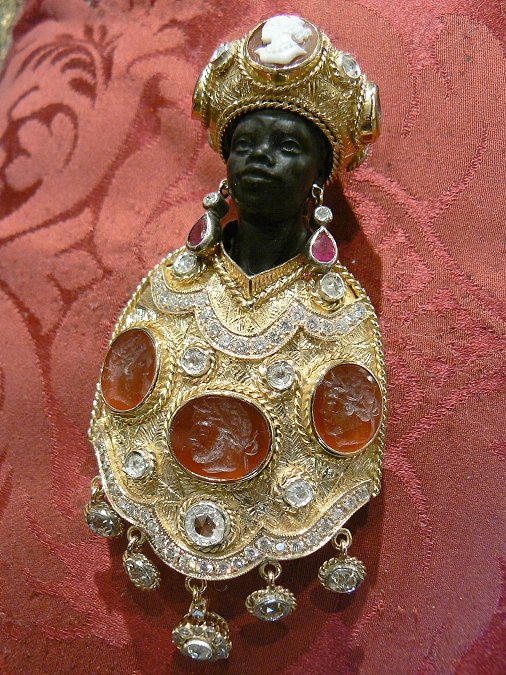
In jewellery the figure is the moretto, Venetian for "little Moor": a brooch, pendant or pair of earrings showing a turbaned head or bust, usually carved in ebony or a dark stone, or enamelled, and set with gold and gems. Venetian jewellers made them into the 1900s, and jewel houses in Venice sold them to visitors.
A separate tradition comes from Rijeka (Fiume) in Croatia. The morčić is a small earring or brooch with the head of a Moor in black enamel under a turban, and it is still made there as a symbol of the city.
Why blackamoor imagery is criticised
The figures show Black people as exotic ornaments or servants, made for the homes and clothes of white Europeans in an age of slavery and colonial rule. For that reason many people find them offensive today. A blackamoor brooch worn at a royal lunch in 2017 drew wide public criticism and an apology. Museums now usually display such pieces with this history explained rather than as simple decoration.
How to recognise a period piece
0 of 4 checked
1The material
Period moretto jewels use carved ebony, dark hardstone or enamel; plastic and resin point to modern costume pieces.
2The setting
Gold and gem settings with hand finishing, not cast base metal.
3The marks
Italian gold marks, a maker’s mark or a jeweller’s signature.
4The wear
Even, natural wear to enamel and carving, not artificial ageing.
Have an antique piece you want identified? Send clear photographs of the front, the back and any marks for a free, honest check.
Free, no obligation, returned at our cost if you decline.
What decides the value of antique jewellery?
For any antique jewel the same things matter: the materials, the maker and marks, the age, the quality of the workmanship, the condition and the provenance. We never publish figures; every piece is different.
Free, no obligation, and returned at our cost if you decline.
Read our Google reviews (opens Google)
- Materials
- Maker and marks
- Age
- Workmanship
- Condition
- Provenance
How selling works
- 1
Send photographs
of the front, the back and any marks, plus anything you know about the piece.
- 2
Free value inspection
We reply within one working day with an estimate, subject to inspection. If our offer differs, you can decline and we return it at our cost.
- 3
Paid the same day after inspection
by bank transfer or in cash, in Mayfair, at our Braintree office, by post or by free collection.
Questions people ask
What is a blackamoor?
In the decorative arts, a European figure of a Black person, usually richly dressed and often posed as a servant or bearer, made from the late 1600s onwards. The word itself is an old English term for a Black African or a Moor.
What is a blackamoor brooch?
A brooch showing the head or bust of a Black figure, usually turbaned and jewelled. In Venice it is called a moretto, "little Moor".
Where did blackamoor figures originate?
In Venice, in the late 1600s and early 1700s, where carvers such as Andrea Brustolon made painted and gilded wooden figures of Black men for wealthy households.
What is a morčić?
A small earring or brooch from Rijeka (Fiume) in Croatia, with the head of a Moor in black enamel under a turban. It is still made there as a symbol of the city.
Why are blackamoor figures controversial?
They show Black people as exotic ornaments or servants, made in an age of slavery and colonial rule, and many people find them offensive today.
Related guides
Have an antique piece you want identified?
Send a few photographs and we will tell you what it is and what it is worth, free.
Free, no obligation, returned at our cost if you decline.