Part of: Cartier Collections and History
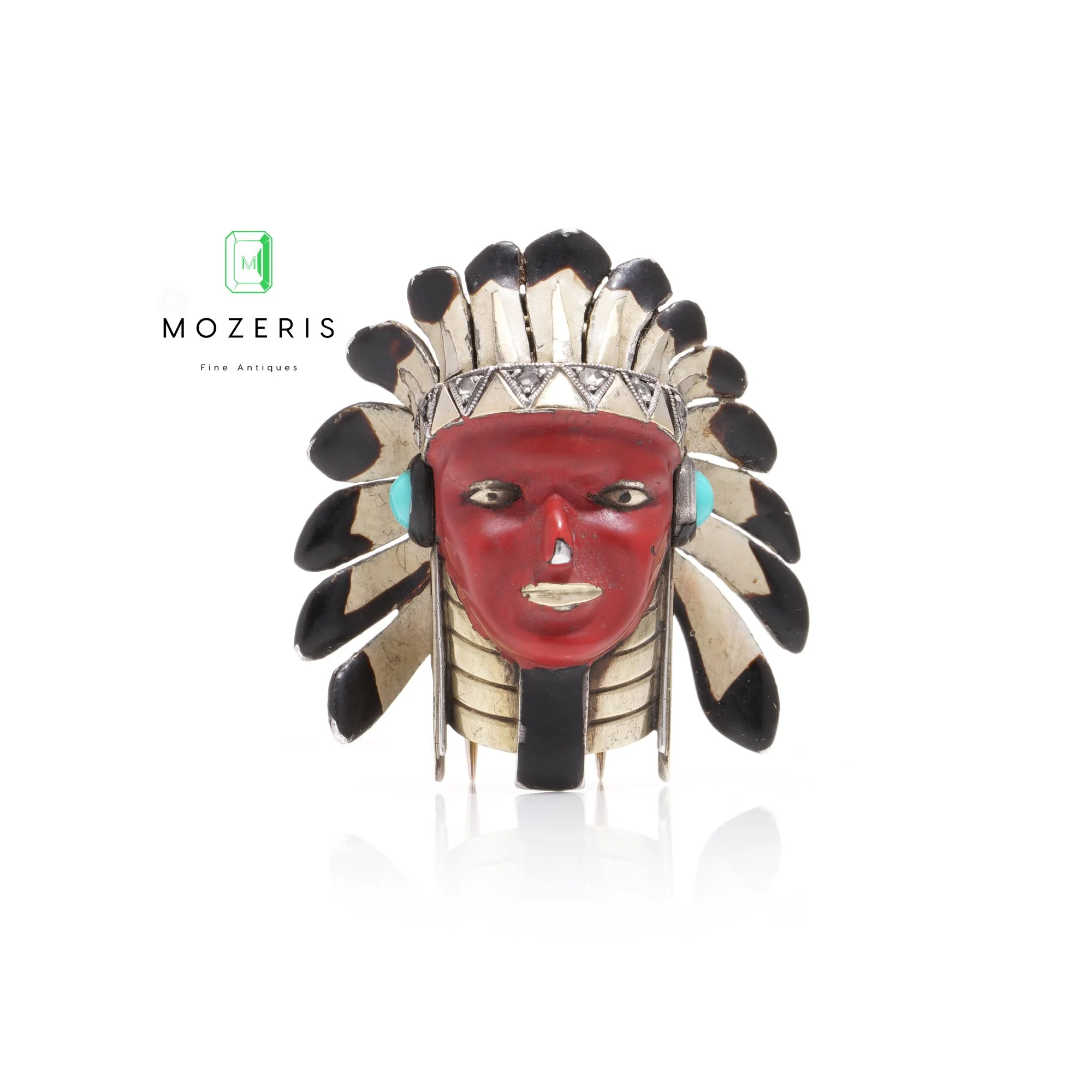
This Cartier brooch of 1938 shows a Native American head in profile, catalogued as the "Sioux Indian Head" brooch, made in gold and silver with diamonds, turquoise and enamel. It belongs to the late Art Deco years, when Cartier made bold figurative brooches in strong colour. This guide describes the piece, places it in its period and explains how signed Cartier brooches are valued.
Own a signed Cartier brooch?
Free, no obligation, returned at our cost if you decline.
- Read our Google reviews (opens Google)
- Free, no obligation
- A reply within one working day
- Paid the same day after inspection
The brooch
The head is shown in profile with a feathered headdress, built in turquoise, diamonds and coloured enamel, set in 18KT gold and silver. Silver-topped gold was the usual way to set diamonds at the time, so they looked white against the metal.


Its period
By 1938, Art Deco was giving way to bolder, more sculptural jewels. Cartier’s figurative brooches of these years, animals, birds and heads, use strong blocks of colour in stones and enamel against diamonds. The design reflects the period’s interest in Native American imagery.
- Art Deco 1920s
- Late Art Deco 1930s
- The brooch, 1938

Check a Cartier brooch
For every house we buy, see how we check designer jewellery.
- 1Signature
- 2Numbers
- 3Marks
0 of 4 checked
1The signature
The signature "Cartier", with London, Paris or New York on some pieces.
2The numbers
Workshop or stock numbers on the pin or frame.
3The marks
Gold and silver marks of the country of making.
4The making
Fine, even setting; enamel without repairs.
Own a signed Cartier brooch? Send photographs of the front and back for a free, honest check.
Free, no obligation, returned at our cost if you decline.
Provenance matters
For a period Cartier jewel, its history counts: a box, a receipt, an old valuation or a traceable owner helps confirm it. Cartier’s archives can sometimes confirm a piece made by the house. We also check important jewels against stolen-property registers.
- 1Box
- 2Receipt
- 3Old valuation
- 4Known owner
- 5Archive
How is a period Cartier brooch valued?
Whether a period Cartier brooch holds its value comes down to the signature and maker’s marks, the design and period, the stones and enamel, its condition and originality, and its provenance. For important jewels we can also sell on consignment for you. No box? We still buy it. We never publish figures.
Free, no obligation, and returned at our cost if you decline.
Read our Google reviews (opens Google)
- Signature
- Design
- Period
- Stones and enamel
- Condition
- Provenance
How selling works
- 1
Send photographs
of the front, the back with its signature and numbers, and any box, receipt or history.
- 2
Free value inspection
We reply within one working day with an estimate, subject to inspection. If our offer differs, you can decline and we return it at our cost.
- 3
Paid the same day after inspection
by bank transfer or in cash, in Mayfair, at our Braintree office, by post or by free collection.
Insured up to £10,000 per parcel when you send to us. For important pieces, we can also sell on consignment for you.
Questions people ask
What is the Cartier Sioux brooch?
A Cartier brooch of 1938 showing a Native American head in profile, catalogued as the "Sioux Indian Head" brooch. It is made in 18KT gold and silver with diamonds, turquoise and enamel, and belongs to Cartier’s late Art Deco figurative brooches.
How do I know a Cartier brooch is genuine?
Look for the "Cartier" signature, sometimes with a city name, workshop or stock numbers, and the gold and silver marks of the country where it was made. The setting and enamel should be fine and even. No single detail proves it. Send photographs of the front and back, and we will check them, free.
How are Cartier Art Deco brooches valued?
On the signature and marks, the design and period, the stones and enamel, the condition and originality, and the provenance, together with current demand. Each is valued on its own. We do not publish prices. Send photographs and any history for a free value inspection.
Do you buy signed Cartier brooches?
Yes. We buy Cartier brooches of every period directly, or sell important pieces on consignment for you, with a free value inspection from photographs and an appointment in Mayfair or at our Braintree office. You are paid the same day after inspection on an outright sale.
Why was silver used with the gold?
In the 1930s diamonds were often set in silver, or in silver-topped gold, so the metal around them looked white and did not tint the stones yellow. Platinum was also used. Gold was kept for the parts that showed colour or took strain, such as the pin.
Should I have an old brooch cleaned before selling?
No. Cleaning can damage enamel and turquoise and loosen old settings. Send photographs first, with the piece as it is. We will tell you how its condition affects the value, and leave any cleaning to the next owner, who can have it done by a specialist.
Related guides
Own a signed Cartier brooch?
Send photographs of the front and back for a free value inspection, with no obligation.
Free, no obligation, returned at our cost if you decline.