Part of: Chinese export silver
Yes. Antique Chinese export silver, made in Canton, Hong Kong and Shanghai from the early 1800s to the 1930s for Western buyers, is collected in the UK for its makers, its marks and its deep relief decoration of dragons, bamboo, prunus and figures. Its value depends far more on the maker, the quality of the work and the type of object than on the silver it contains. Signed pieces by makers such as Wang Hing, Tuck Chang and Luen Wo, and finely chased dragon pieces, are the most sought after.
Have Chinese silver to sell?
Free, no obligation, returned at our cost if you decline.

- Read our Google reviews (opens Google)
- Free, no obligation
- A reply within one working day
- Paid the same day after inspection
What is Chinese export silver?
Chinese export silver was made by Chinese silversmiths for Western merchants, travellers and residents. It includes tea and coffee services, cups, bowls, boxes, napkin rings, cigarette cases, trophies and dressing-table pieces. Early pieces copy English shapes; later pieces are covered in Chinese decoration in high relief.


A short history
- Early 1800s
- What to expect
- Canton makers copy English Georgian silver, often with pseudo-hallmarks imitating English marks
- Mid to late 1800s
- What to expect
- Chinese decoration takes over: bamboo, dragons, flowers, landscapes and figures
- About 1870 to 1930s
- What to expect
- Hong Kong and Shanghai makers such as Wang Hing, Tuck Chang and Luen Wo; deep repoussé and chasing
- After the 1930s
- What to expect
- Production for export declines
How to read the marks
- Maker’s mark. Chinese characters for the retailer or maker, often with Latin initials such as WH for Wang Hing.
- Standard mark. Many pieces are stamped "90" or a similar number for the silver content; some carry "Sterling".
- Pseudo-hallmarks. Early Canton silver may carry marks imitating English hallmarks; they are not British assay marks.
Decoration to look for
0 of 4 checked
1Dragons
Coiling dragons in high relief, as on our dragon box.
2Bamboo and prunus
Common on cups, saucers and tea wares, like our Wang Hing cups.
3Characters
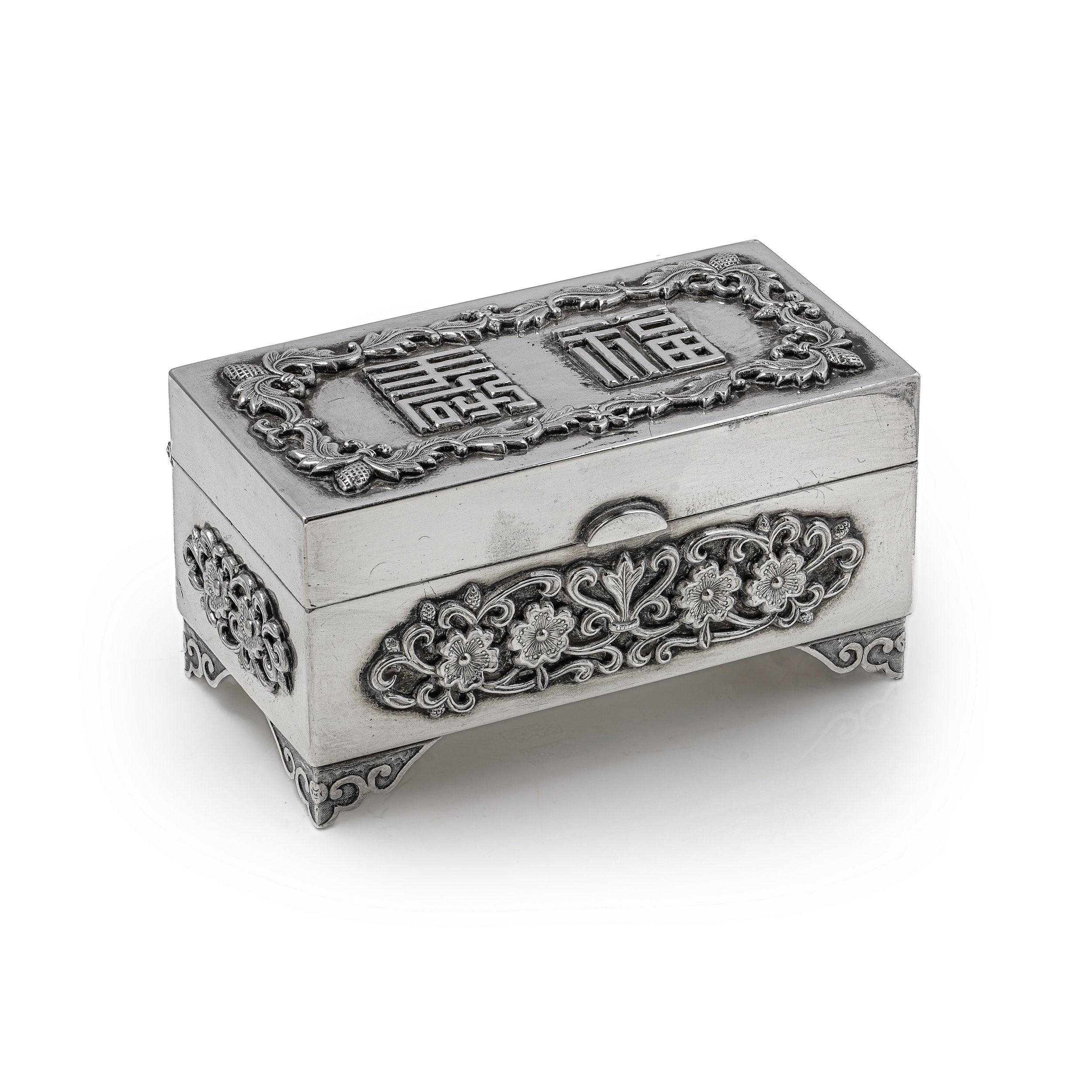
Auspicious characters such as fu (good fortune) and shou (long life), as on our small box.
4Figures and landscapes
Battle scenes, scholars and pagodas, chased in detail.
Have Chinese silver to sell? Send clear photographs of the piece and every mark for a free, honest check.
Free, no obligation, returned at our cost if you decline.
What makes Chinese silver valuable?
The maker and marks (Wang Hing and the other Hong Kong and Shanghai makers lead), the quality and depth of the chasing, the subject (dragons and figure scenes are sought after), the type and size of the object, a complete set, the condition and any provenance. We never publish figures; every piece is different.
Free, no obligation, and returned at our cost if you decline.
Read our Google reviews (opens Google)
- Maker
- Chasing
- Subject
- Object type
- Set
- Condition
How selling works
- 1
Send photographs
of the piece from several sides and every mark.
- 2
Free value inspection
We reply within one working day with an estimate, subject to inspection. If our offer differs, you can decline and we return it at our cost.
- 3
Paid the same day after inspection
by bank transfer or in cash, in Mayfair, at our Braintree office, by post or by free collection.
Questions people ask
Is Chinese silver valuable?
Antique Chinese export silver is collected in the UK. Its value depends mainly on the maker, the decoration and the type of object.
How do I identify Chinese export silver?
Look for Chinese character marks, often with Latin initials and a number such as "90", and Chinese decoration such as dragons, bamboo or figures in relief.
Who was Wang Hing?
One of the best-known makers and retailers of Chinese export silver, working in Hong Kong and Canton in the late 1800s and early 1900s; pieces are often marked WH.
What does "90" mean on Chinese silver?
It indicates the silver content claimed by the maker, around 90 per cent.
Is Chinese silver sterling?
Some pieces are marked sterling, but many Chinese export pieces are marked with their own standard, such as "90".
What are pseudo-hallmarks?
Marks on early Canton silver that imitate English hallmarks; they are not British assay marks.
Related guides
Have a piece of Chinese silver?
Send a few photographs and we will tell you what it is and what it is worth, free.
Free, no obligation, returned at our cost if you decline.
Thinking of selling? Find out how to sell your silver with a free valuation from photographs.