Fu Lu Shou: Who Are the Three Star Gods?
Part of: The shou symbol
Fu Lu Shou are the Three Star Gods of Chinese tradition, together called Sanxing, "the Three Stars". Fu stands for good fortune, Lu for rank and prosperity, and Shou for long life. They are shown as three robed figures and are among the most popular subjects in Chinese porcelain, carving and painting, given and displayed as a wish for a happy, successful and long life.
Have a Chinese figure or piece with the Three Star Gods?
Free, no obligation, returned at our cost if you decline.
- Read our Google reviews (opens Google)
- Free, no obligation
- A reply within one working day
- Paid the same day after inspection
Who are Fu, Lu and Shou?
- Fu
- Character
- 福 fú
- Stands for
- Good fortune and happiness
- How he is usually shown
- Often in the centre, holding a child or a scroll
- Lu
- Character
- 祿 lù
- Stands for
- Rank, success and prosperity
- How he is usually shown
- In the robes and hat of a court official, often holding a ruyi sceptre
- Shou
- Character
- 壽 shòu
- Stands for
- Long life
- How he is usually shown
- An old man with a high, domed forehead, holding a peach and a staff
Together they express the three things a traditional Chinese household wished for: happiness, an honoured career with its rewards, and a long life in which to enjoy them.

Shou, the god of long life
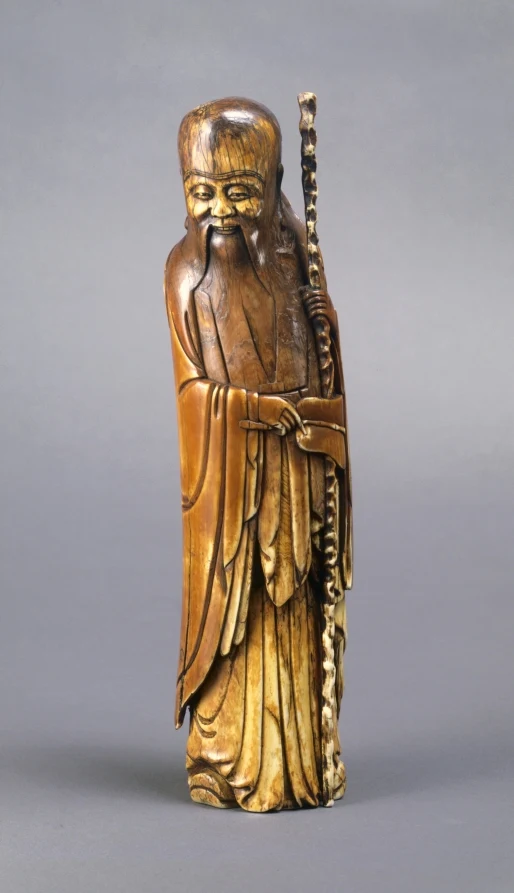
Shou, also called Shouxing or Shoulao, "Old Man Longevity", is the easiest of the three to recognise. His forehead is high and domed, his beard long and white, and he carries a peach of immortality and a knotted staff, sometimes hung with a gourd. A crane or a deer often stands beside him. He is linked with Canopus, the bright star of the southern sky, known in China as the Star of the Old Man of the South Pole. He also appears on his own, very often, as on the Ming ivory figure shown here.
How the Three Stars are written in pictures
Chinese art often stands for the Three Stars by objects whose names sound like their names:
- A bat for Fu: the word for bat, fú 蝠, sounds like fú 福, good fortune.
- A deer for Lu: the word for deer, lù 鹿, sounds like lù 祿, prosperity.
- A peach, a crane or the character 壽 for Shou: all long-life symbols.
A bat, a deer and a peach together on a vase or a panel are a picture of Fu Lu Shou without the figures at all.
Where the Three Star Gods appear on antiques
- Porcelain: figures and groups of the three, and vases and plates painted with them, from the Ming dynasty to the 1900s.
- Blanc de Chine: white porcelain figures of Shoulao from Dehua in Fujian.
- Carving: figures in ivory, wood, bamboo, soapstone and jade, like the Ming figure shown here.
- Furniture and panels: carved and inlaid scenes, and the shou character itself, as on the campaign table fragment.
- Textiles and paintings: birthday hangings, robes and scrolls.
How to read a Three Star Gods piece
0 of 4 checked
1Identify the figures
Identify the figures by their attributes: child or scroll for Fu, official’s robes and ruyi for Lu, domed head and peach for Shou.
2Look at the material and making
Crisp carving, fine painting and even glazes point to good work.
3Look at the base
Reign marks on porcelain were copied for centuries, so a mark is a starting point, not proof of age.
4Check for repairs
Fingers, staffs and sceptres are fragile and often restored.
Have a Chinese figure or piece with the Three Star Gods? Send clear photographs of the front, the back and the base for a free, honest check.
Free, no obligation, returned at our cost if you decline.
What makes a Three Star Gods piece valuable?
The material, the age and period, the quality of the carving or painting, any genuine marks, the condition and the provenance. The subject is common, so quality and age decide. We never publish figures; every piece is different. Items in ivory are subject to UK law and need specialist advice before any sale.
Free, no obligation, and returned at our cost if you decline.
Read our Google reviews (opens Google)
- Material
- Period
- Workmanship
- Marks
- Condition
- Provenance
How selling works
- 1
Send photographs
of the front, the back, the base and any marks.
- 2
Free value inspection
We reply within one working day with an estimate, subject to inspection. If our offer differs, you can decline and we return it at our cost.
- 3
Paid the same day after inspection
by bank transfer or in cash, in Mayfair, at our Braintree office, by post or by free collection.
Questions people ask
What does Fu Lu Shou mean?
Good fortune (fú), rank and prosperity (lù) and long life (shòu): the three blessings of Chinese tradition, shown as the Three Star Gods.
Who are the Three Star Gods?
Fu, Lu and Shou, together called Sanxing, "the Three Stars". They stand for happiness, success and long life.
How do you tell Fu, Lu and Shou apart?
Shou is the old man with a domed forehead, a peach and a staff. Lu wears an official’s robes and hat and often holds a ruyi sceptre. Fu is often in the centre, holding a child or a scroll.
Why do Chinese decorations show bats and deer?
Because their names sound like blessings: bat (fú) like good fortune, deer (lù) like prosperity.
Are Fu Lu Shou figures given as gifts?
Yes. Figures and paintings of the Three Star Gods are traditional gifts for birthdays, weddings and the New Year.
Is Shou the same as Shoulao?
Yes. Shou, Shouxing and Shoulao are names for the same god of long life.
Related guides
Have a Chinese antique you want identified?
Send a few photographs and we will tell you what it is and what it is worth, free.
Free, no obligation, returned at our cost if you decline.