Part of: Art Deco jewellery
A makeup compact is a small case holding face powder, a puff and a mirror, made to be carried and used in public. People have carried cosmetics in small boxes since antiquity, but the compact as we know it took off in the early 1900s, when it became acceptable for women to powder their faces in public. The 1920s and 1930s were its golden age: jewellers such as Cartier, Van Cleef & Arpels and Lacloche made compacts in gold, enamel and gemstones, while firms in Britain and America made them in silver and metal for everyone.
Have a vintage gold, silver or enamel compact?
Free, no obligation, returned at our cost if you decline.

- Read our Google reviews (opens Google)
- Free, no obligation
- A reply within one working day
- Paid the same day after inspection
Before the compact
Ancient Egyptians kept kohl and creams in small jars of stone and faience, and Romans carried cosmetics in little boxes. In the 1700s and 1800s fashionable women used patch boxes, rouge pots and vinaigrettes, often of silver, gold or enamel. Make-up itself was still used discreetly, and powder was applied at home rather than in public.

The rise of the powder compact
In the early 1900s attitudes changed. Women worked, travelled and went out more, and pressed powder became easy to carry. A small case with a mirror in the lid and a puff over the powder let women powder their noses in public, and by the 1920s the compact was an everyday accessory.
The golden age: 1920s and 1930s
- Jewellers’ compacts. Cartier, Van Cleef & Arpels, Boucheron and Lacloche Frères made compacts in gold, platinum, enamel and lacquer, set with diamonds and coloured stones, often in Art Deco and Chinoiserie designs like our Lacloche compact.
- The minaudière. In the 1930s Van Cleef & Arpels introduced the minaudière, a jewelled case holding compact, lipstick and other essentials in one.
- Guilloché enamel. Engine-turned metal under translucent enamel was a favourite finish for silver and gold compacts.
- Everyday compacts. British firms such as Stratton and Kigu, and American makers, produced compacts in silver, gilt metal and enamel in large numbers.
Compacts after the war
Compacts remained popular through the 1950s, with novelty shapes, musical compacts and souvenir designs. As loose powder gave way to modern cosmetics in plastic cases, the decorative compact became a collectors’ item.
How to identify a vintage compact
- Marks
- What it tells you
- Hallmarks date British silver and gold; a maker’s signature such as Cartier or Lacloche is important
- Finish
- What it tells you
- Guilloché enamel, lacquer and gem-setting point to finer work
- Inside
- What it tells you
- Original mirror, puff and sifter add to completeness
- Box
- What it tells you
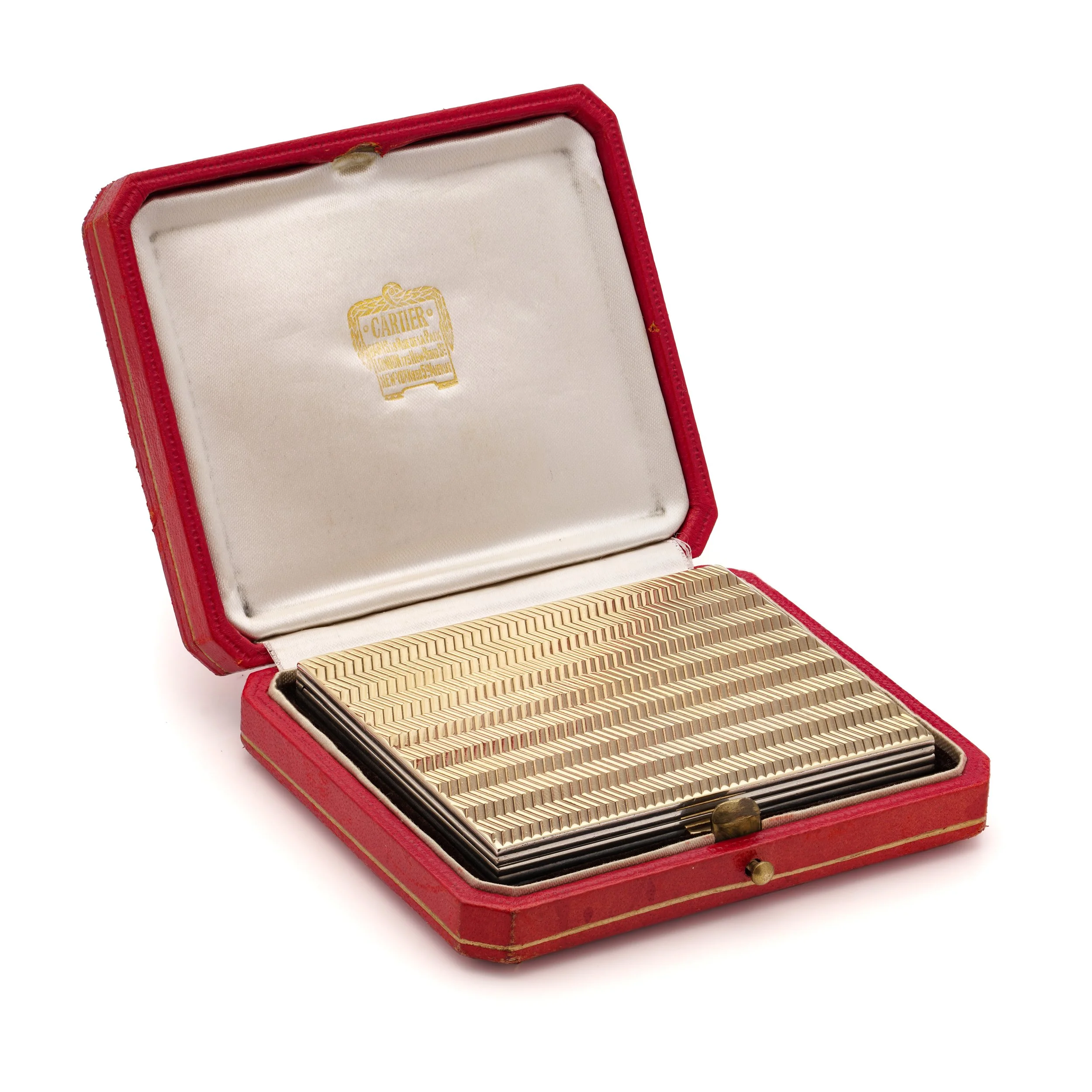
- An original fitted case or box, like the red box in our photograph, adds interest
- Condition
- What it tells you
- Check hinges, clasps, enamel chips and mirror damage
Have a vintage gold, silver or enamel compact? Send clear photographs of the outside, the inside and any marks for a free, honest check.
Free, no obligation, returned at our cost if you decline.
What makes a vintage compact valuable?
The maker (signed jewellers’ compacts are the most sought after), the metal and marks, the design and period, enamel or gemstones, the condition, completeness inside and any original box. We never publish figures; every piece is different.
Free, no obligation, and returned at our cost if you decline.
Read our Google reviews (opens Google)
- Maker
- Metal and marks
- Design
- Enamel or gems
- Condition
- Box
How selling works
- 1
Send photographs
of the outside, the inside and every mark, plus any box.
- 2
Free value inspection
We reply within one working day with an estimate, subject to inspection. If our offer differs, you can decline and we return it at our cost.
- 3
Paid the same day after inspection
by bank transfer or in cash, in Mayfair, at our Braintree office, by post or by free collection.
Questions people ask
When were compact mirrors invented?
Small cosmetic boxes are ancient, but the powder compact with a mirror in the lid became popular in the early 1900s and was an everyday accessory by the 1920s.
What is a makeup compact?
A small case holding pressed or loose face powder, a puff and a mirror, made to carry and use when out.
Who made the most famous compacts?
Jewellers such as Cartier, Van Cleef & Arpels, Boucheron and Lacloche made luxury compacts in the 1920s and 1930s; Stratton and Kigu were well-known British makers of everyday compacts.
What is a minaudière?
A jewelled evening case holding a compact, lipstick and other essentials, introduced by Van Cleef & Arpels in the 1930s.
Are vintage compacts collectable?
Yes. Signed jewellers’ compacts and fine silver and enamel compacts are collected, especially complete with their puffs, mirrors and boxes.
How do I date a silver compact?
British silver compacts carry hallmarks with a date letter, which gives the year of assay.
Related guides
Have a compact to sell?
Send a few photographs and we will tell you what it is and what it is worth, free.
Free, no obligation, returned at our cost if you decline.