Part of: Antique silver
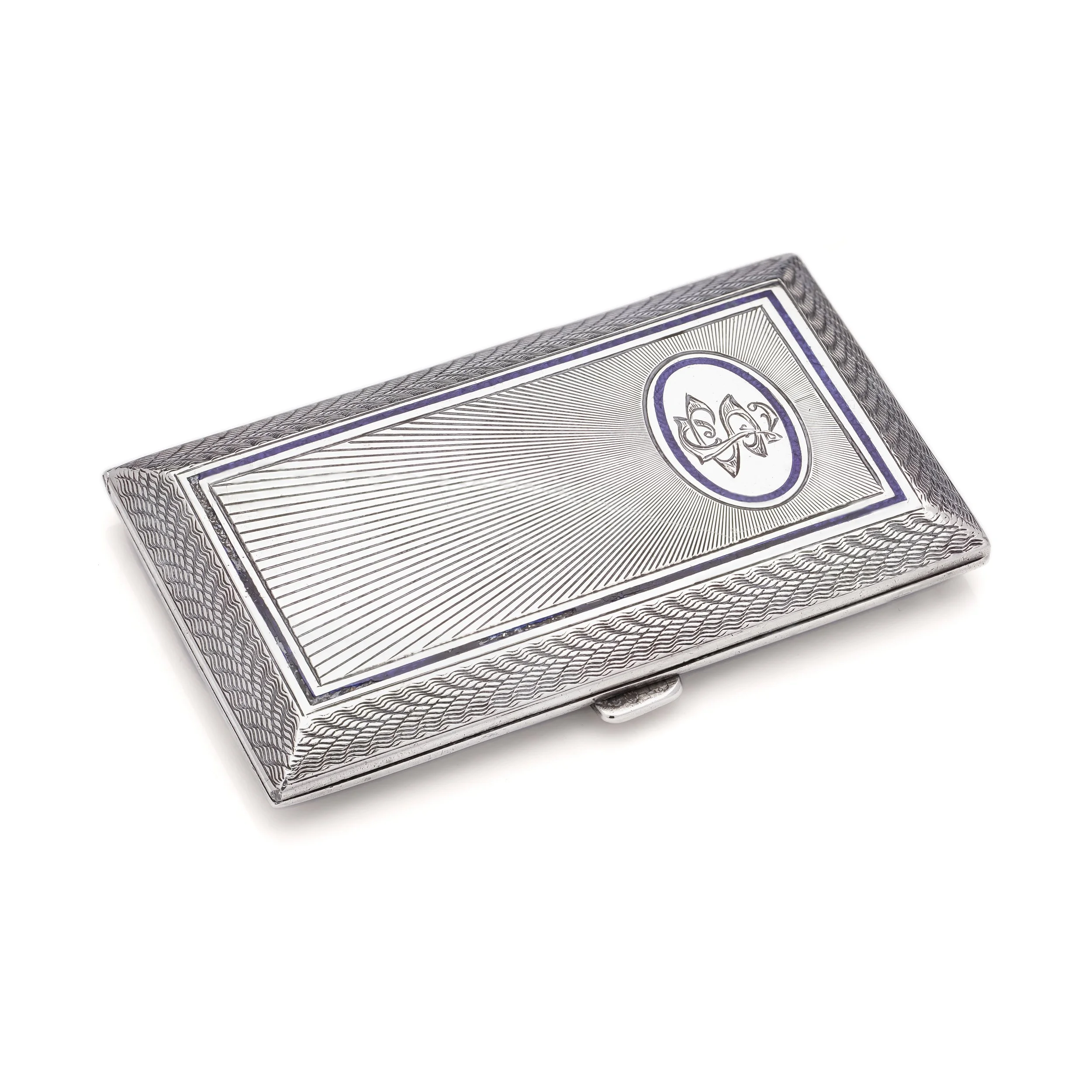
A cigarette case is a flat, hinged box made to carry cigarettes in a pocket or handbag without crushing them. Cases became common in the late 1800s, when cigarettes replaced cigars and pipes as the everyday way to smoke. Because a case was handled and shown in company, it was also made as a fine object: in silver and gold, engine-turned, enamelled, set with stones or engraved with a monogram. Today antique cigarette cases are collected for their makers, their metalwork and their marks.
Have a silver or gold cigarette case?
Free, no obligation, returned at our cost if you decline.
- Read our Google reviews (opens Google)
- Free, no obligation
- A reply within one working day
- Paid the same day after inspection
What a cigarette case was for
- Protection. Early cigarettes were soft and easily crushed or damp; a rigid case kept them straight and dry.
- Carrying. Many cases are gently curved to sit flat in a jacket pocket, with a sprung clasp so they open with one hand.
- Holding the cigarettes. Inside, an elastic band or a hinged clip holds the cigarettes in place.
- Lighting. Some cases have a compartment for matches, a striker, or, on Russian cases, a channel for a tinder cord.
- Presentation. Cases were given as gifts and engraved with monograms, dates, regimental badges and dedications.


A short history
Cigarettes spread through Britain after the Crimean War of the 1850s, and machine rolling from the 1880s made them cheap and plentiful. Silver cigarette cases followed in large numbers, and Birmingham became the centre of British production. By the early 1900s cases were made for women as well as men, and in the 1920s and 1930s they were an everyday accessory, alongside the compact and the lighter.

Cigarette cases by origin
- British silver. Hallmarked cases, often engine-turned, from plain pocket cases to heavy presentation pieces.
- Russian. Silver, silver-gilt and gold cases from St Petersburg and Moscow: guilloché enamel like our case by Andrey Adler, niello, cloisonné enamel and carved hardstone such as nephrite, often with a cabochon sapphire thumbpiece. Fabergé workmasters, among them August Holmström, made cases for the firm.
- Austrian and German. Silver cases with engine turning, niello or enamel, many from the decades either side of 1900.
- Japanese. Komai damascene cases of iron inlaid with gold and silver, made for export in the late 1800s and early 1900s.
- Art Deco. Cartier, Boucheron and Van Cleef & Arpels made cases in gold, platinum, enamel and lacquer, some with matching compacts.
How to identify an antique cigarette case
- Hallmarks
- What it tells you
- British marks give the maker, the assay office and the year; Russian marks show the silver standard (84 or 88) and the city
- Maker's mark
- What it tells you
- A known maker, such as a Fabergé workmaster, is a major point of interest
- Decoration
- What it tells you
- Guilloché enamel, niello, hardstone and gem-set thumbpieces point to finer work
- Inside
- What it tells you
- Original gilding, elastic or clip, and any inscription
- Condition
- What it tells you
- Check the hinge, the clasp, dents, enamel chips and wear to the gilding
Have a silver or gold cigarette case? Send clear photographs of the outside, the inside and the marks for a free, honest check.
Free, no obligation, returned at our cost if you decline.
What makes a cigarette case valuable?
The maker and marks (Fabergé and the great jewellers are the most sought after), the metal, the decoration (enamel, niello, hardstone, gems), the quality of the work, the condition and any inscription or provenance. We never publish figures; every piece is different.
Free, no obligation, and returned at our cost if you decline.
Read our Google reviews (opens Google)
- Maker
- Metal
- Decoration
- Quality
- Condition
- Provenance
How selling works
- 1
Send photographs
of the outside, the inside and every mark.
- 2
Free value inspection
We reply within one working day with an estimate, subject to inspection. If our offer differs, you can decline and we return it at our cost.
- 3
Paid the same day after inspection
by bank transfer or in cash, in Mayfair, at our Braintree office, by post or by free collection.
Questions people ask
What is the purpose of a cigarette case?
To carry cigarettes in a pocket or bag without crushing or dampening them. Many were also made as fine objects and gifts.
When were cigarette cases first used?
They became common in the late 1800s, as cigarettes spread after the Crimean War and machine-made cigarettes appeared in the 1880s.
Are antique cigarette cases collectable?
Yes. Silver, gold and enamelled cases are collected for their makers, decoration and marks.
How do I date a silver cigarette case?
British cases carry hallmarks with a date letter for the year of assay; Russian cases carry marks for the silver standard, the city and the maker.
What is a vesta case?
A small box for matches, often carried alongside a cigarette case; some cigarette cases have a match compartment built in.
Why do Russian cigarette cases have a cord?
Some have a channel for a tinder cord, which was lit and used to light the cigarette.
Related guides
Have a cigarette case to sell?
Send a few photographs and we will tell you what it is and what it is worth, free.
Free, no obligation, returned at our cost if you decline.
Thinking of selling? Find out how to sell your silver with a free valuation from photographs.