Guide to Art Nouveau Jewellery
Guide to Art Nouveau Jewellery
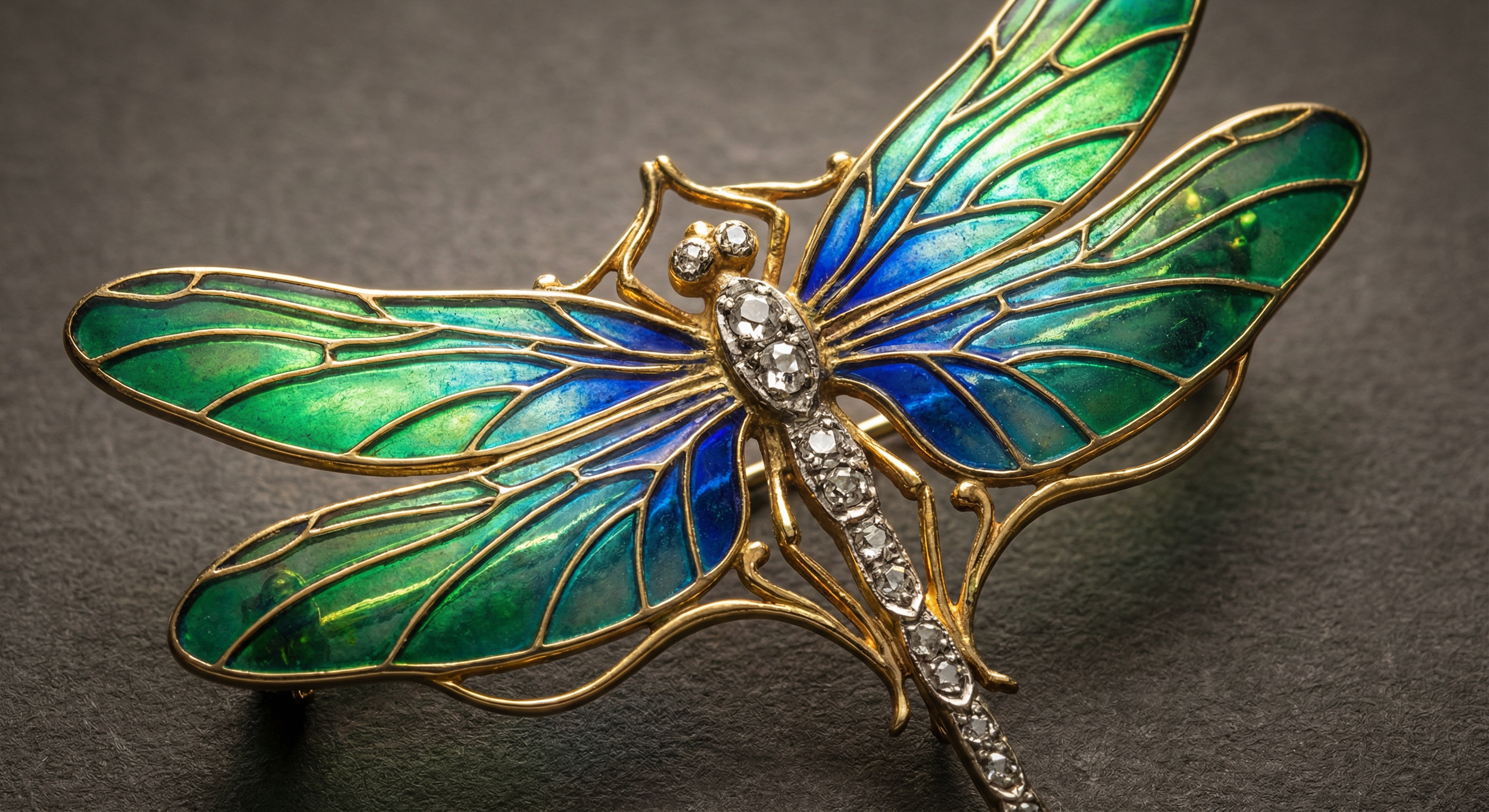
Art Nouveau jewellery is a highly artistic style created roughly between 1890 and 1914, characterised by flowing lines, nature-inspired motifs and sculptural metalwork. Instead of focusing purely on gemstones, makers such as René Lalique and Liberty & Co used plique-a-jour enamel, opals, moonstones and pearls to create painterly pieces that feel almost like wearable illustrations. Authentic examples are increasingly sought after, especially when signed, in original condition and offered by a specialist who understands the period.
- Art Nouveau jewellery sits roughly between c.1890–1914 and is defined by whiplash curves, natural forms and the celebration of the female figure.
- Typical materials include gold, silver-gilt, plique-a-jour and translucent enamels, opals, moonstones, pearls and old-cut diamonds.
- Key makers include René Lalique, Georges Fouquet, Liberty & Co, Murrle Bennett, Philippe Wolfers and Louis Comfort Tiffany.
- Good pieces feel sculptural and hand-made, with flowing, asymmetrical designs rather than strict symmetry and straight lines.
- Condition of enamel, quality of design, maker’s signature and the originality of fittings are critical value drivers.
- If you own Art Nouveau jewellery, a specialist appraisal can reveal whether your piece is a decorative trinket or a serious collector’s item.
- What is Art Nouveau jewellery?
- Art Nouveau jewellery timeline (c. 1890–1914)
- Key motifs and symbolism
- Materials and techniques
- Famous Art Nouveau jewellers and makers
- How to identify authentic Art Nouveau jewellery
- Dating Art Nouveau jewellery by era
- Art Nouveau vs Art Deco jewellery
- Is Art Nouveau jewellery valuable?
- Common pitfalls and reproductions
- FAQ: Art Nouveau jewellery

What is Art Nouveau jewellery?
Art Nouveau jewellery emerged in the late nineteenth century as artists and makers reacted against heavy historic revival styles. Instead of drawing on classical or Renaissance ornament, designers looked to nature, Japanese art and Symbolist painting for inspiration. The result was jewellery that behaves almost like sculpture: gold and silver twist into whiplash curves, enamel becomes as important as gemstones, and the human figure is treated as part of an overall composition.
In France and Belgium the style is often called Style Moderne or Jugendstil, while in Britain it is closely linked to the Arts and Crafts movement and the work of Liberty & Co in London. Although the movement is relatively short-lived, it leaves behind some of the most expressive jewels of the modern period.
If you enjoy exploring period pieces by era you may also like our guides to Victorian jewellery, Edwardian jewellery and Art Deco jewellery, or browse our antique rings and brooches.
Art Nouveau jewellery timeline (c. 1890–1914)
Art Nouveau does not begin on a single day. It emerges gradually in the 1890s and burns brightly for roughly twenty-five years.

| Period | Date range | Key features | Representative makers |
|---|---|---|---|
| Early experiments | c. 1890–1895 | First departures from historic revival styles; nature motifs appear in brooches and pendants, often with modest use of enamel. | Early work by Lalique, Wolfers, Liberty & Co designers. |
| Peak Art Nouveau | c. 1895–1905 | Highly sculptural jewels with bold female profiles, dragonflies, irises, peacocks and swirling lines. Extensive plique-a-jour and translucent enamels, opals and moonstones. | René Lalique, Georges Fouquet, Philippe Wolfers, Louis Comfort Tiffany, Murrle Bennett. |
| Late Art Nouveau / transitional | c. 1905–1914 | Simplified forms, more geometry entering the designs, and overlap with early Art Deco. Stylised floral line is still present but layouts become cleaner. | Liberty & Co, Maison Vever, small workshop jewellers across Europe. |
Key Art Nouveau motifs and symbolism
Motif choice is one of the easiest ways to recognise Art Nouveau jewellery. Designers favoured subjects that felt alive and fluid rather than static or architectural.

- Whiplash lines – long, whirling curves that seem to move across the jewel, sometimes framing stones or figures.
- Flowers and plants – irises, lilies, poppies, ginkgo leaves and other species with elegant, elongated forms.
- Insects – dragonflies, butterflies, beetles and bees; wings are often enamelled in translucent colours.
- Peacocks and birds – valued for their sweeping tails and decorative feathers.
- Female figures – nymphs and muses with flowing hair, often emerging from foliage or blending into the frame of the jewel.
- Mythology and symbolism – references to dreams, the night, metamorphosis and the natural cycle of life.

Materials and techniques in Art Nouveau jewellery
While earlier nineteenth-century jewellery often concentrates value in large diamonds and high-carat gold, Art Nouveau pieces treat metal and enamel as media for art in their own right. Understanding the materials will help you recognise genuine work and assess quality.
Precious metals
- Gold and gold alloys – typically 14ct or 18ct yellow gold, sometimes with a softer, greenish tone that suits botanical motifs. Check gold values for current pricing.
- Gold and silver combinations – gold used for outlines, with silver or silver-gilt backings to support enamel and stones.
- Platinum – more associated with Edwardian jewels, but occasionally used for fine outlines or settings in higher-end pieces.

Gemstones
- Opals and moonstones – their shifting colours and soft glow were perfect for dream-like compositions.
- Old-cut diamonds – used as accents and outlines rather than the sole centre of attention; see our diamond rings for period styles.
- Pearls and seed pearls – provide softness and texture along sinuous lines.
- Coloured stones – emeralds, sapphires, rubies, amethysts, peridots and garnets are often used in smaller, carefully placed sizes.

Enamel techniques
Enamel is central to the Art Nouveau aesthetic. It allowed jewellers to paint with colour and light in a way gemstones alone could not achieve.
- Plique-a-jour – often compared to stained glass; translucent enamel is suspended between gold ribs with no backing, perfect for dragonfly wings and petals.
- Translucent and transparent enamels – applied over engraved metal to create depth and shimmer.
- Opaque enamels – used for bolder colour areas, especially in Liberty & Co and Arts and Crafts pieces.


Famous Art Nouveau jewellers and makers
Many Art Nouveau jewels are unsigned, but a number of master jewellers leave an identifiable body of work. Signed examples can command substantial premiums.
- René Lalique – perhaps the most celebrated Art Nouveau jeweller, known for ethereal pieces combining horn, glass, enamel and gems. His jewels often feature female profiles, dragonflies and peacocks.
- Georges Fouquet – Parisian jeweller whose shop was redesigned by Alphonse Mucha. His work features strong compositions and rich colour.
- Philippe Wolfers – Belgian designer whose jewels are sculptural and dramatic, often featuring mythological creatures.
- Liberty & Co (London) – their “Cymric” and “Tudric” ranges popularised Art Nouveau and Arts and Crafts design in Britain, using silver and enamel in accessible, wearable forms.
- Murrle Bennett & Co – produced German-made jewels sold through Liberty; often marked and very collectable today.
- Louis Comfort Tiffany – in the United States, Tiffany Studios produced glass and jewels that share the Art Nouveau love of nature and colour.

How to identify authentic Art Nouveau jewellery
Because Art Nouveau is visually distinctive, most genuine pieces trigger a strong first impression. A more systematic checklist helps you separate authentic period work from later imitations.
Art Nouveau identification checklist
- Overall impression – does the jewel feel fluid, organic and pictorial rather than rigid or heavily symmetrical?
- Motifs – look for irises, lilies, dragonflies, butterflies, peacocks, female profiles and flowing hair.
- Lines and layout – check for whiplash curves, asymmetry and compositions that lead the eye around the piece.
- Materials – examine the use of enamel, opals, moonstones, seed pearls and old-cut diamonds in harmony with the design.
- Construction – under magnification, genuine pieces show hand-finished detail, subtle file marks and carefully shaped settings.
- Hallmarks and signatures – look for appropriate gold or silver hallmarks for the country of origin and, where present, maker’s marks such as MB&Co or Liberty.
- Wear and patina – period jewels show honest age: tiny scratches, softened edges and gentle wear rather than sharp, newly cast surfaces.

Dating Art Nouveau jewellery by era
Because Art Nouveau overlaps with late Victorian and early Edwardian jewellery, dating can require a combination of stylistic judgement and hallmark knowledge. The table below summarises the main cues.
| Era | Date range | Key visual cues | Materials and marks |
|---|---|---|---|
| Late Victorian | c. 1870–1890 | Symmetrical layouts, cluster rings, star-set gypsy rings, sentimental motifs and conservative palettes. | High-carat gold, old mine-cut diamonds, turquoise, garnets. British hallmarks with earlier date letters. |
| Art Nouveau | c. 1890–1914 | Flowing, asymmetrical designs, nature and female figures, enamel used as a major design element. | 14ct–18ct gold and silver-gilt, opals, moonstones, pearls, enamel. Continental or British hallmarks from the turn of the century. |
| Edwardian / Belle Époque | c. 1901–1915 | Light, lacy jewels with bows, garlands and swags; overall symmetry and a delicate look. | Platinum and gold, diamonds and pearls. Fine millegrain settings. |
| Art Deco | c. 1920–1939 | Strong symmetry, geometric motifs, stepped and radiating designs, bold colour contrasts. | Platinum, white gold, diamonds, onyx, jade, coral. Later hallmarks and maker’s marks. |
If you are unsure whether a piece is late Art Nouveau or early Art Deco, focus on the line of the design. Curving, plant-like lines generally indicate earlier work, while strict geometry and repeated shapes point to later styles. Our Art Deco jewellery and Art Deco engagement rings offer useful visual comparison.
Art Nouveau vs Art Deco jewellery
These two styles are frequently confused, especially when a jewel carries both curves and some geometric detailing. A side-by-side comparison highlights the main differences.

| Feature | Art Nouveau jewellery | Art Deco jewellery |
|---|---|---|
| Lines | Curved, flowing, asymmetrical. | Straight, stepped, strongly symmetrical. |
| Motifs | Flowers, insects, birds, female figures. | Sunbursts, chevrons, zigzags, architectural forms. |
| Colour | Soft pastels, opalescent stones, painterly enamels. | High contrast: black and white, bold primary colours. |
| Materials | Gold, silver-gilt, enamel, opals, moonstones, pearls. | Platinum, white gold, diamonds, onyx, jade, coral. |
Is Art Nouveau jewellery valuable?
Fine Art Nouveau jewels can command strong prices at auction and through specialist dealers, particularly when they unite excellent design, rare materials and good condition. Even simpler pieces often attract collectors who enjoy the period’s distinctive look. If you own a piece and want to understand its value, a specialist valuation is the first step.
| Value driver | Impact on value | Example |
|---|---|---|
| Maker | Signed jewels by top houses such as Lalique, Tiffany or Wolfers are among the most desirable and are often recorded in reference books. | A Lalique enamel and opal pendant with full signature will be worth many multiples of a similar unsigned piece. |
| Design quality | Pieces with strong composition, balanced motifs and sophisticated use of colour are more sought after than simple applied ornament. | A sculptural nymph pendant framed by irises versus a basic stamped floral locket. |
| Condition | Enamel loss, replaced stones or crude repairs can reduce value significantly. | A brooch with intact plique-a-jour wings will always outperform one with extensive restoration. |
| Original fittings | Retaining the original clasp, brooch fitting or chain is attractive to collectors. | A pendant on its original Liberty & Co chain is more appealing than one on a modern replacement. |
| Provenance | Documented history, especially links to exhibitions or notable collections, adds interest and stability of value. | A jewel illustrated in a period catalogue or exhibition guide. |
Common pitfalls and reproductions
Because Art Nouveau jewellery is visually distinctive, it has been copied many times. Some copies were made only a decade or two after the originals, while others are far more recent. A cautious approach helps you avoid disappointment.
Common fakes and mistakes
- Modern cast copies – often lack crisp detail; the backs can look dull and slightly granular rather than sharply finished.
- “Art Nouveau style” but modern construction – uses modern safety catches, bright-white solder and stones cut in contemporary styles.
- Married pieces – genuine elements combined with later frames or chains; look for mismatched wear between parts.
- Over-restored enamel – repainting sits flat and lifeless compared with original vitreous enamel.
- Misattributed makers – unsigned pieces occasionally receive optimistic attributions; always be wary of marks that look sharp on heavily worn metal.
If you are considering selling or insuring an Art Nouveau jewel, a professional assessment from a specialist can distinguish a decorative piece from one with significant collector interest. We offer free, no-obligation valuations at our Braintree showroom or by insured post.
Own an Art Nouveau jewel?
If you own Art Nouveau jewellery and are considering selling, our specialists provide discreet, no-obligation valuations with fast payment options.
Get your free valuationExplore similar pieces
Browse period jewels with Art Nouveau influence in our curated collections.
Browse full jewellery collectionFAQ: Art Nouveau jewellery
What is Art Nouveau jewellery?
Art Nouveau jewellery is a style produced mainly between about 1890 and 1914 that celebrates flowing lines, the natural world and the female form. Designers treated jewels as miniature artworks rather than just settings for stones, using gold, silver-gilt, enamel and atmospheric gems such as opals and moonstones to create dream-like compositions.
What years are considered Art Nouveau?
For jewellery, Art Nouveau begins to appear in the early 1890s, reaches a high point around the 1900 Paris Exposition Universelle and gradually fades by the start of the First World War. In Britain the style overlaps with late Victorian and Edwardian jewellery, while on the Continent it sits between historic revival pieces and the geometry of Art Deco.
How can you tell if a piece of jewellery is Art Nouveau?
Look first at the line of the design. If the metalwork twists and flows like stems or tendrils, and if the subject matter is botanical, insect or female, you are likely in Art Nouveau territory. Enamel that feels integral to the design, opals or moonstones used as luminous centres, and carefully modelled figures are also strong indicators. Checking hallmarks and construction against the 1890–1914 date range then helps confirm your impression.
Is Art Nouveau jewellery the same as Edwardian jewellery?
No. Art Nouveau and Edwardian jewellery overlap in time but differ in intention. Edwardian pieces focus on lightness, lace-like platinum mounts and symmetrical garlands, often with diamonds and pearls. Art Nouveau jewellery is more experimental, with sculptural forms, coloured enamel and motifs that feel almost otherworldly. It is quite possible to own a collection that includes both styles representing different sides of the same period.
Is Art Nouveau jewellery valuable?
Well-designed Art Nouveau jewellery can be very desirable. Signed work by makers such as Lalique, Fouquet or Wolfers sits at the top of the market, but attractive unsigned jewels by good workshops are also collected. Condition of enamel, originality of fittings and the overall strength of the design all play a major role in value. If you think you may have an Art Nouveau piece, arranging a specialist valuation is worthwhile.
Should I restore damaged Art Nouveau enamel?
Minor wear and small, stable losses are usually best left alone, as they tell part of the object’s history. Heavy or poorly matched restoration can actually reduce market appeal. If enamel damage is severe enough to threaten the structure of the jewel or its wearability, consult a restorer who specialises in historic enamels and request a conservation-led approach rather than a cosmetic overhaul.
How should I wear Art Nouveau jewellery today?
Art Nouveau jewels look particularly striking when given space to breathe: a pendant on a simple chain, a brooch pinned to a plain jacket or a single statement ring. Because many pieces are over a century old, avoid exposing them to harsh perfumes, hairspray or prolonged direct sunlight, and remove them before vigorous activity.