Guide to Art Deco Jewellery
Guide to Art Deco Jewellery
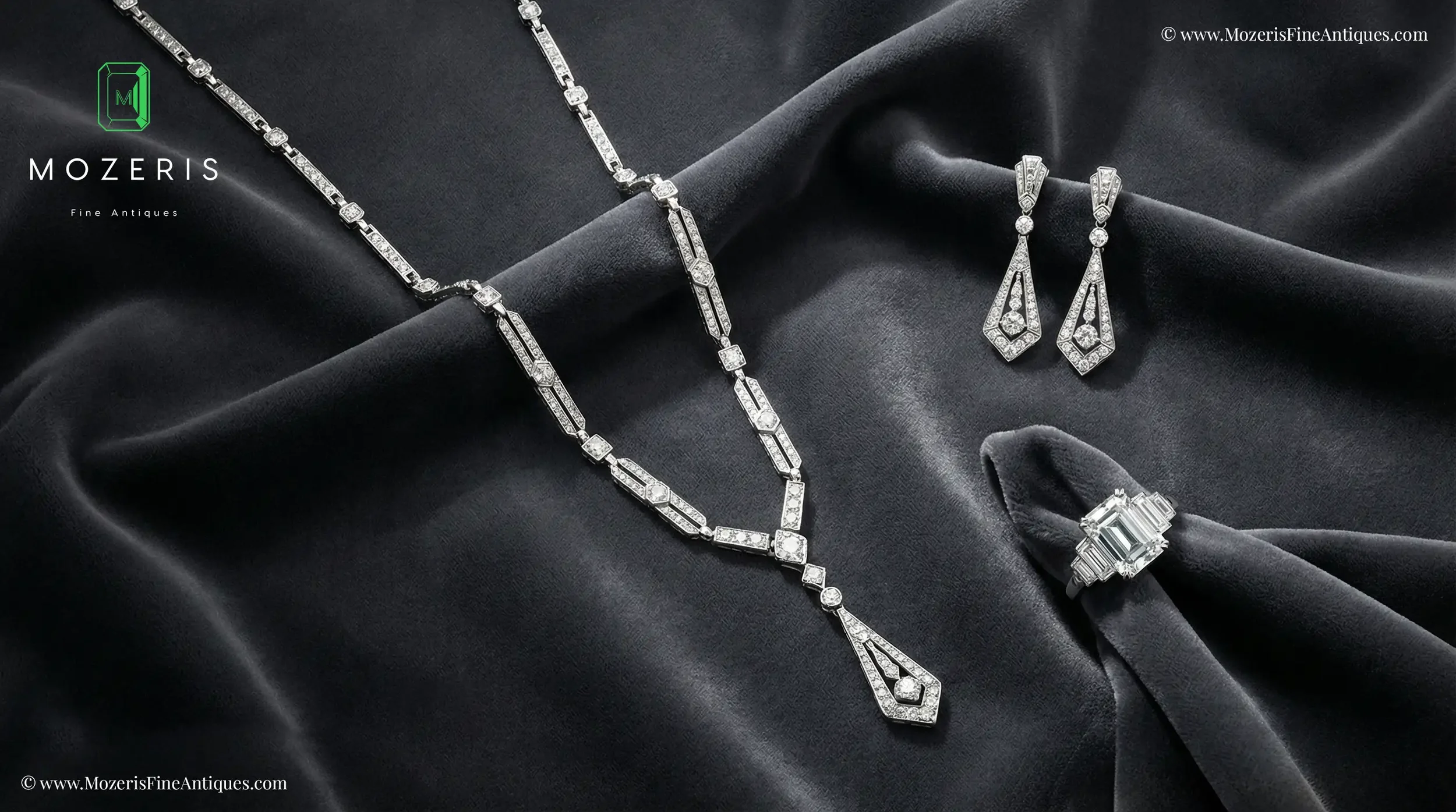
Art Deco jewellery is a bold, geometric style produced roughly from the 1920s to the late 1930s. It favours straight lines, stepped settings, sunbursts and strong colour contrast—typically platinum or white gold with diamonds, onyx, jade and calibré-cut coloured stones. Vintage and antique Art Deco rings, bracelets and brooches remain highly collectable; genuine period pieces are best verified and valued by a specialist.
- Art Deco jewellery dates from roughly 1920 to the late 1930s and is defined by symmetry, geometry and an architectural feel.
- Typical materials include platinum, white gold, diamonds (emerald, baguette, old European cut), onyx, jade, coral, sapphires and rubies.
- Key motifs: sunbursts, chevrons, zigzags, stepped patterns, fan shapes and bold colour blocks.
- Famous names include Cartier, Van Cleef & Arpels, Boucheron and Raymond Templier; signed pieces command a premium.
- Authentic Art Deco shows period construction, appropriate stone cuts and consistent wear; fakes often look too sharp or use modern materials.
- If you own Art Deco jewellery, a specialist valuation can confirm authenticity and value.
- What is Art Deco jewellery?
- Art Deco jewellery timeline (c. 1920–1939)
- Key Art Deco motifs and design rules
- Materials and stones in Art Deco jewellery
- Famous Art Deco jewellers and designers
- How to identify authentic Art Deco jewellery
- Art Deco vs Art Nouveau jewellery
- Art Deco rings: engagement, cocktail and wedding bands
- Is Art Deco jewellery valuable?
- Common pitfalls and fakes
- FAQ: Art Deco jewellery

What is Art Deco jewellery?
Art Deco jewellery emerged after the First World War as the opposite of the flowing, nature-inspired Art Nouveau style. Designers drew on Cubism, ancient Egypt, the machine age and the 1925 Paris Exposition des Arts Décoratifs to create jewels that were geometric, symmetrical and boldly modern. Straight lines, stepped settings, sunbursts and strong contrasts—black onyx with diamonds, or jade with platinum—define the look.
Whether you are buying an Art Deco engagement ring, a vintage bracelet or a brooch, recognising the period’s design language helps you spot genuine pieces and avoid reproductions. Explore our antique rings, earrings and necklaces by era, or read our guides to Edwardian and Victorian jewellery for context.
Art Deco jewellery timeline (c. 1920–1939)
The term “Art Deco” comes from the 1925 Exposition Internationale des Arts Décoratifs et Industriels Modernes in Paris, but the style had already been taking shape in the early 1920s and continued into the late 1930s.

| Period | Date range | Key features |
|---|---|---|
| Early Art Deco | c. 1920–1925 | Transition from Edwardian lightness to bolder geometry; platinum and diamonds remain dominant; Egyptian revival begins after Tutankhamun (1922). |
| High Art Deco | c. 1925–1930 | Paris Exposition influence; strong symmetry, sunbursts, calibré-cut stones, onyx and jade; cocktail rings and long sautoirs; Cartier, Van Cleef, Boucheron at their peak. |
| Late Art Deco | c. 1930–1939 | Softer curves begin to reappear; larger gemstones; white gold more common as platinum supply tightens; streamline and “retro” elements. |
Key Art Deco motifs and design rules
Art Deco jewellery obeys a clear visual grammar: symmetry, repetition and geometry over organic flow.

- Sunbursts and rays – radiating lines from a central point, often framing a gem or forming the whole design.
- Chevrons and zigzags – repeated V-shapes and angular lines that suggest speed and modernity.
- Stepped and tiered forms – layered, architectural shapes that echo skyscrapers and ziggurats.
- Fan shapes – semicircular or segmental patterns, often in bracelets and brooches.
- Bold colour blocks – black onyx with white diamonds, jade with rubies, or coral with sapphires.
- Egyptian revival – scarabs, lotus, hieroglyph-inspired patterns and lapis after the discovery of Tutankhamun’s tomb.
Materials and stones in Art Deco jewellery
Art Deco favours cool, crisp metals and a mix of transparent and opaque stones to create contrast.
Metals
- Platinum – the preferred metal for fine Art Deco work; strong, white and ideal for delicate openwork and millegrain.
- White gold – often rhodium-plated to match platinum; became more common in the 1930s.
- Yellow gold – used in some gold Art Deco rings and bracelets, especially later or more casual pieces.
- Silver and base metals – used in costume jewellery; marcasite and rhinestone pieces are collectable but not fine jewellery.

Stones
- Diamonds – emerald cut, baguette, old European and old mine cuts; calibré-cut diamonds fitted into geometric patterns. See our diamond engagement rings.
- Onyx – black onyx with diamonds is one of the most iconic Art Deco combinations.
- Jade and coral – carved or cabochon, used for colour blocks and Egyptian-inspired designs.
- Sapphires, rubies, emeralds – often calibré-cut or in geometric settings; see our sapphire, ruby and emerald engagement rings.
- Other stones – aquamarine, amethyst, moonstone and paste (glass) in costume pieces.
Famous Art Deco jewellers and designers
Signed Art Deco jewellery by major houses commands a significant premium. Key names include:
- Cartier – geometric bracelets, Tutti Frutti, and iconic Art Deco rings and bracelets.
- Van Cleef & Arpels – invisible setting (sertissage à jour), diamond and coloured-stone designs.
- Boucheron – bold colour and architectural forms.
- Raymond Templier – avant-garde geometric designs in platinum.
- Mauboussin, Chaumet, Lacloche – other Parisian houses with strong Art Deco output.
- Costume and unsigned – many attractive Art Deco pieces are unsigned or by smaller makers; condition and design still drive value.

How to identify authentic Art Deco jewellery
Genuine Art Deco jewellery has a consistent “grammar”: symmetry, period-appropriate stone cuts and metalwork that shows the right age and construction.
Art Deco identification checklist
- Overall shape – symmetrical, geometric, with straight or stepped lines rather than soft curves.
- Motifs – sunbursts, chevrons, zigzags, fan shapes, or Egyptian-inspired elements.
- Stone cuts – emerald, baguette, old European, old mine, or calibré; avoid modern brilliant cuts in “period” pieces.
- Metal – platinum or white gold for fine jewellery; check hallmarks and wear consistency.
- Construction – hand-finished details, appropriate solder and settings; no modern casting texture or laser welds.
- Wear and patina – honest age-consistent wear; newly sharp edges on heavily worn metal suggest a copy.

Art Deco vs Art Nouveau jewellery
Art Nouveau and Art Deco are often contrasted: the first is organic and flowing, the second geometric and architectural.

| Feature | Art Nouveau | Art Deco |
|---|---|---|
| Lines | Curved, flowing, asymmetrical. | Straight, stepped, symmetrical. |
| Motifs | Flowers, insects, female figures. | Sunbursts, chevrons, zigzags, fans. |
| Materials | Gold, enamel, opals, moonstones. | Platinum, white gold, diamonds, onyx, jade. |
| Era | c. 1890–1914 | c. 1920–1939 |
For more on the earlier style, see our Guide to Art Nouveau jewellery.
Art Deco rings: engagement, cocktail and wedding bands
Art Deco engagement rings are among the most sought-after period styles. They typically feature a central emerald-cut, old European or cushion-cut diamond with baguette or calibré side stones in platinum or white gold. Vintage Art Deco engagement rings from the 1920s and 1930s offer a distinct look compared with modern designs.

Cocktail rings—large, statement rings worn to parties—were a 1920s and 1930s staple. Art Deco wedding bands are often geometric, with alternating diamonds and metal, or narrow eternity bands with calibré stones. Men’s Art Deco rings include signet and pinkie rings in geometric patterns; browse our signet rings and antique rings for similar styles.


Is Art Deco jewellery valuable?
Fine Art Deco jewellery is highly collectable. Signed pieces by Cartier, Van Cleef & Arpels and comparable houses, and unsigned pieces with strong design and good condition, can command strong prices. Value depends on materials, design, condition and provenance.
| Factor | Impact |
|---|---|
| Maker | Signed work by major houses carries a substantial premium. |
| Materials | Platinum and diamond pieces generally outperform silver or costume. |
| Design | Distinctive geometric design and colour contrast add value. |
| Condition | Original settings, no major damage or crude repairs. |
| Provenance | Documented history or exhibition can support value. |
If you own Art Deco jewellery and want to know its worth, we offer free, no-obligation valuations at our Braintree showroom or by insured post. We also buy gold, silver and watches.
Common pitfalls and fakes
Art Deco style has been reproduced for decades. Copies range from period “revival” pieces to modern fakes. Watch for:
Red flags
- Modern casting – granular or soft detail on the back; surfaces that look too uniform.
- Wrong stone cuts – round brilliant or modern cuts in a piece sold as 1920s–30s.
- Metal – base metal or poor-quality gold with a “too white” rhodium finish.
- Hallmarks – sharp, deep marks on worn metal; incorrect date letters or assay marks for the style.
- Married pieces – period stone in a new setting, or new stone in period setting; check consistency of wear.
A specialist can confirm whether your piece is genuine Art Deco and advise on valuation or sale.
Own Art Deco jewellery?
Get a free, no-obligation valuation. We offer in-person appointments in Braintree, insured postal service and quick opinions via WhatsApp.
Get your free valuationShop Art Deco & period jewellery
Browse our curated antique and vintage jewellery by era and type.
Browse full collectionFAQ: Art Deco jewellery
What defines an Art Deco ring?
An Art Deco ring is defined by geometric, symmetrical design: straight lines, stepped or tiered settings, and motifs such as sunbursts, chevrons and fan shapes. Typical features include emerald-cut, baguette or calibré-cut diamonds and coloured stones, set in platinum or white gold, with a bold, architectural look dating from roughly 1920 to the late 1930s.
Is Art Deco jewellery worth anything?
Yes. Genuine Art Deco jewellery can be very valuable. Platinum and diamond pieces, signed work by houses such as Cartier or Van Cleef & Arpels, and strong geometric design in good condition command strong prices. Costume and reproduction pieces have more modest value. A specialist valuation will clarify what your piece is worth.
How do I spot a fake Art Deco ring?
Fakes often show modern casting texture, overly sharp edges, contemporary stone cuts (e.g. brilliant cuts where old European or old mine would be correct), wrong metal (e.g. bright white rhodium over base metal), or hallmarks that look newly struck on worn metal. Genuine period pieces have appropriate wear, period-appropriate cuts and construction, and consistent hallmarks.
What stones suit Art Deco rings?
Art Deco rings typically use diamonds (emerald, baguette, old European and calibré cuts), sapphires, rubies, emeralds, onyx, jade, coral and sometimes aquamarine or amethyst. The style favours bold colour contrast—for example black onyx with diamonds—and geometrically cut or calibré-set stones.
How can you tell if jewellery is Art Deco?
Look for strong symmetry, geometric shapes (sunbursts, zigzags, chevrons, stepped patterns), straight lines and angular design. Materials are typically platinum, white gold, diamonds and bold contrasts such as black onyx with diamonds. Curving, organic and nature-focused pieces are more likely Art Nouveau or Edwardian.
Is Edwardian the same as Art Deco?
No. Edwardian jewellery (c. 1901–1915) is light, lace-like and delicate, with garlands and millegrain-set diamonds in platinum. Art Deco (c. 1920–1939) is geometric, bold and architectural. They are different eras and aesthetics.
Is Art Deco jewellery valuable?
Fine Art Deco jewellery is highly collectable and often valuable. Signed pieces by famous houses, platinum and diamond work, and distinctive design in good condition drive value. Costume and reproduction pieces are less valuable. A professional valuation will confirm authenticity, materials and market value.