Part of: Sell your Chopard jewellery
Chopard began in 1860 as the workshop of Louis-Ulysse Chopard in Sonvilier, in the Swiss Jura, making precise pocket watches. In 1963 the Scheufele family, goldsmiths and watchmakers from Pforzheim, bought the firm and added jewellery. In 1976 it introduced diamonds that move freely behind glass, now its signature. This guide tells the story and points to our collection guides.
Own a Chopard piece?
Free, no obligation, returned at our cost if you decline.
- Read our Google reviews (opens Google)
- Free, no obligation
- A reply within one working day
- Paid the same day after inspection
Pocket watches from the Jura
Louis-Ulysse Chopard set up his workshop in Sonvilier in 1860. His pocket watches became known for their accuracy and were sold well beyond Switzerland, including to clients in the Russian Empire.


The Scheufele family
In 1963 Karl Scheufele III, from a family of German jewellers and watchmakers in Pforzheim, bought Chopard with his wife Karin. They kept its watchmaking and added gold jewellery, and their children, Caroline and Karl-Friedrich, went on to lead the jewellery and watches.
- 1860Founded
- 1963Scheufele
- 1976Moving diamonds
- Today


Diamonds that move
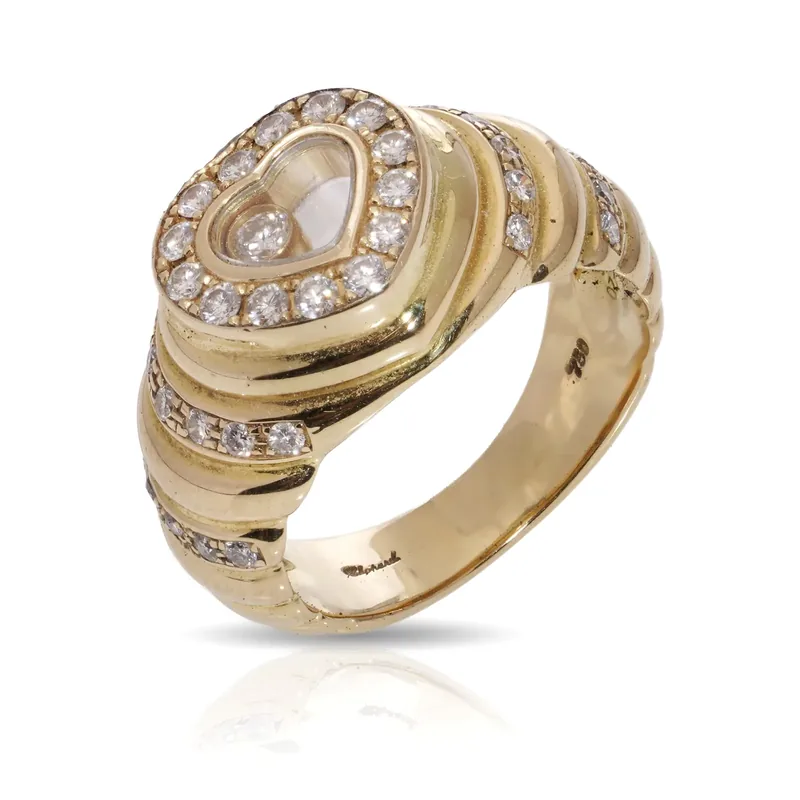
In 1976 Chopard set loose diamonds between two sapphire crystals so they slide as the wearer moves. First seen in a watch, the idea became Happy Diamonds, and later Happy Hearts and Happy Sport. Our Happy Diamonds and Happy Hearts guides cover each line, how to check one and value.
- 1Loose diamond between two sapphire crystals
- 2Linking down to both guides


Check a Chopard piece
For every house we buy, see how we check designer jewellery.
- 1Signature
- 2Serial
- 3750
0 of 4 checked
1The signature
The signature "Chopard", with a serial number.
2The marks
The marks 750 and Swiss marks.
3The moving stones
Gliding freely, crystals clear.
4The papers
A certificate whose number matches.
Own a Chopard piece? Send a photo of the back and the front for a free, honest check.
Free, no obligation, returned at our cost if you decline.


What is my Chopard piece worth?
Whether a Chopard piece holds its value comes down to the collection and piece, the diamonds, the gold colour, its condition (scratched crystals, stuck stones), and whether you have the box and certificate. No box or certificate? We still buy it. We never publish figures.
Free, no obligation, and returned at our cost if you decline.
Read our Google reviews (opens Google)
- Collection
- Diamonds
- Gold
- Condition
- Papers
How selling works
- 1
Send photographs
of the front, the back with its signature and serial, and any box or certificate.
- 2
Free value inspection
We reply within one working day with an estimate, subject to inspection. If our offer differs, you can decline and we return it at our cost.
- 3
Paid the same day after inspection
by bank transfer or in cash, in Mayfair, at our Braintree office, by post or by free collection.
Insured up to £10,000 per parcel when you send to us.
Questions people ask
When was Chopard founded?
In 1860, when Louis-Ulysse Chopard opened a watchmaking workshop in Sonvilier, in the Swiss Jura. It made precise pocket watches for clients across Europe and in the Russian Empire, before the Scheufele family, from Pforzheim in Germany, bought it in 1963.
Who owns Chopard?
The Scheufele family, goldsmiths and watchmakers from Pforzheim in Germany, who bought Chopard in 1963. Karl Scheufele III and his wife Karin added jewellery to the watchmaking, and their children Caroline and Karl-Friedrich lead the house today, Caroline as co-president and artistic director.
When did Chopard introduce moving diamonds?
In 1976, with loose diamonds held between two sapphire crystals so they move freely. The idea became the Happy Diamonds collection, followed later by Happy Hearts and Happy Sport. Our Happy Diamonds and Happy Hearts guides explain each line in detail.
How do I know my Chopard is genuine?
Look for the "Chopard" signature with a serial, 750 on gold, and on moving-diamond pieces, stones that glide freely behind clear crystals. A certificate with a matching number helps. No single detail proves it. Send photographs of the front and back, and we will check them, free.
How much is my Chopard worth?
It depends on the collection and piece, the diamonds, the gold colour, the condition and whether you have the box and certificate, together with current demand. We do not publish prices. Send photographs for a free value inspection within one working day.
Where can I sell Chopard?
To a buyer who checks the signature, serial and any moving stones in person. We buy Chopard jewellery and watches directly: a free value inspection from photographs, then an appointment in Mayfair or at our Braintree office, Special Delivery post or free collection. You are paid the same day after inspection, by bank transfer or in cash.
Related guides
Own a Chopard piece?
Send a photograph of the front and back for a free value inspection, with no obligation.
Free, no obligation, returned at our cost if you decline.
