Antique Jewellery as an Investment: An Honest Guide
Most articles on this subject are written to sell you something, so they skip the parts that matter: what it really costs to buy and sell a jewel, and what can go wrong. This one doesn't.
We sell jewellery at this level — and we would rather you bought it understanding both the case for it and the costs of it, because the buyers who do are the ones who come back.
Quick answer: is antique jewellery a good investment?
Fine antique jewellery can hold and sometimes grow its value — but it is not an investment product. It pays no income, costs money to insure, and carries a real spread between what you pay and what you would get back. The sensible framing: buy pieces you genuinely want to own, at the quality level where rarity protects your downside.
Above roughly £10,000, bought well, antique jewellery has historically been a respectable store of value. Bought badly, it is an expensive lesson at any price.
Start with the uncomfortable economics
When you buy from any dealer — us included — you pay a retail price that includes sourcing, authentication, restoration, overheads and margin. If you sold the same piece back to the trade the next day, you would receive a trade price. Depending on the piece, that gap commonly runs 25–50%.
The spread is the hurdle every jewel must clear before it "performs". Auction is no escape — premiums and commissions take a similar bite.
This is not a reason to avoid fine jewellery. It is the reason to buy quality, rarity and signatures — the segment where demand is deep enough that the spread narrows and values genuinely move — and to buy with a holding period measured in years, not months. It is also why "cheap" antique jewellery is usually the worst investment of all: the spread is proportionally widest exactly where resale demand is thinnest.
What genuinely holds value
Five factors, in roughly descending order of power:
- A signature from a great house. Cartier, Van Cleef & Arpels, Tiffany, Boucheron. At auction, signed period pieces consistently sell at multiples of unsigned equivalents of identical intrinsic quality. The signature carries the archive, the design language, and a global collector base. Our signed jewellery guide covers this in depth.
- Genuine rarity of type. Natural (un-farmed) pearls; important old-cut diamonds; intact tremblants; matched Deco double-clips; documented Georgian survivals. Categories where no more can ever be made — and where supply shrinks every year through loss and breaking.
- Natural, untreated stones — certified. A sapphire certificated "no evidence of heat treatment" occupies a different market from a treated stone of the same look. For pearls, a laboratory report confirming natural origin can multiply value several-fold.
- Original, unmolested condition. The trade pays for surfaces never over-polished, mechanisms that work, stones that match, fittings never swapped. Restoration has its place; originality commands the premium.
- Provenance. Documented history — receipts, fitted cases, archive extracts, notable ownership — adds a layer of value that cannot be faked and travels with the piece.
A jewel scoring on several of these is what the trade loosely calls investment-grade. A jewel scoring on none is decoration — it may be lovely, but it should be bought as pleasure, not stored value.
The two-tier market
The market has split. The lower tier — mass Victorian gold, ordinary vintage, anything abundant — is soft: supply outstrips a shrinking casual demand. The upper tier — rare, signed, natural-stone pieces — has been strong, with recent seasons producing record results at the major auction houses for exactly the categories above. The practical consequence: the middle is a trap. A £3,000 piece that is merely "nice" sits in the weakest part of the curve. At £10,000 and above, if you are buying on the five drivers, you are buying where demand is deepest and most international.
The risks nobody lists
Illiquidity
A jewel can take months to sell at full value. If you might need the money quickly, this is the wrong asset.
No income — and running costs
Shares pay dividends; jewellery pays insurance premiums, typically 1–2% of value per year. That is a real cost of ownership.
Taste risk
Categories fall from fashion — ask anyone who bought heavy 1980s gold at its peak. Rarity and signatures date far more slowly than styles, which is precisely why they are the safer buy.
Condition & authenticity risk
Damage is expensive at this level, and added signatures, married pieces and treated stones exist. Written authentication and certificates matter more as prices rise.
A note on UK tax — useful, and rarely written
Jewellery is a chattel for UK capital gains tax. Two points worth knowing: disposals with proceeds of £6,000 or less are generally exempt from CGT, and a marginal relief can soften the charge above that. Unlike some collectables bought as "wasting assets", jewellery does not qualify as one — so larger gains can be taxable. Keep records of what you paid.
Three ways collectors buy at this level
Illustrated with pieces we currently hold — not because you must buy them, but because concrete examples beat abstractions:

The rarity thesis
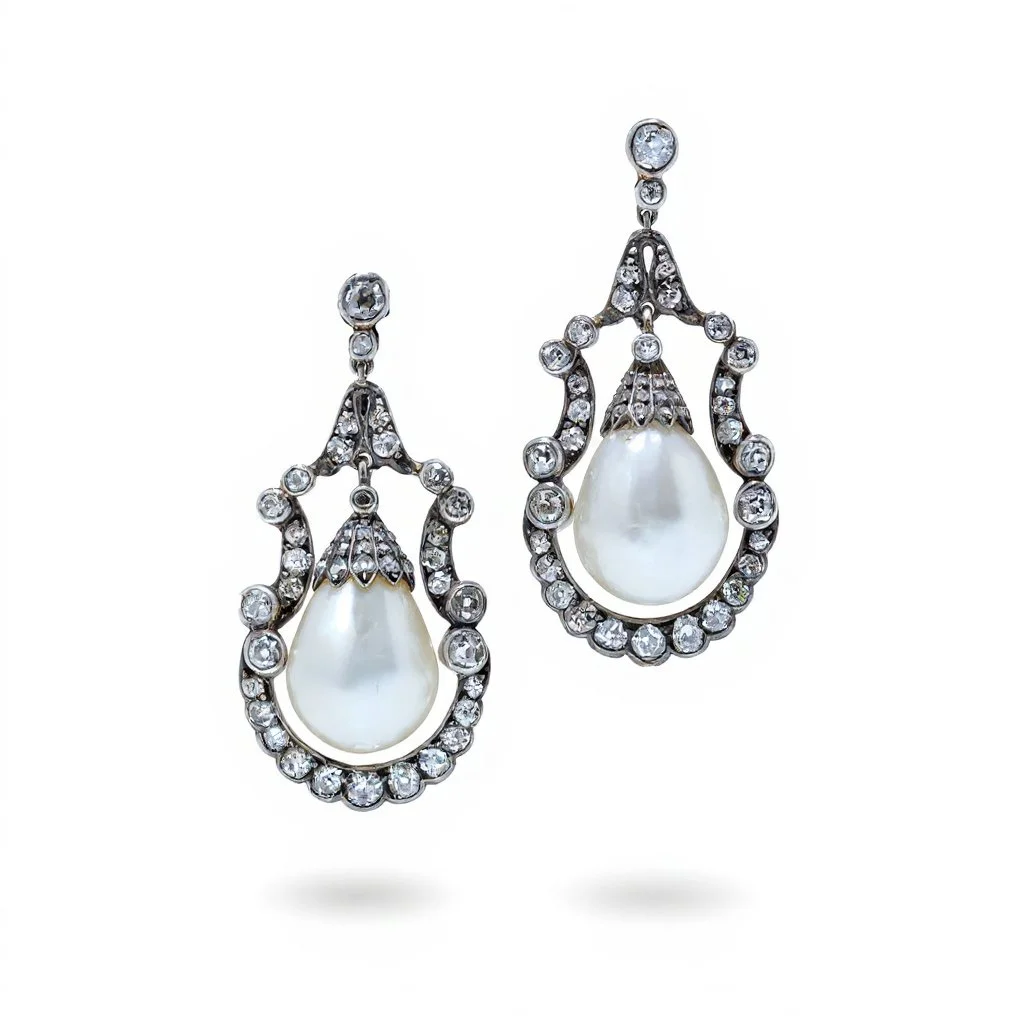
Material that cannot be made again. The Victorian natural-pearl drops are wild pearls pre-dating farming — the scarcest mainstream gem material there is.
The connoisseur thesis
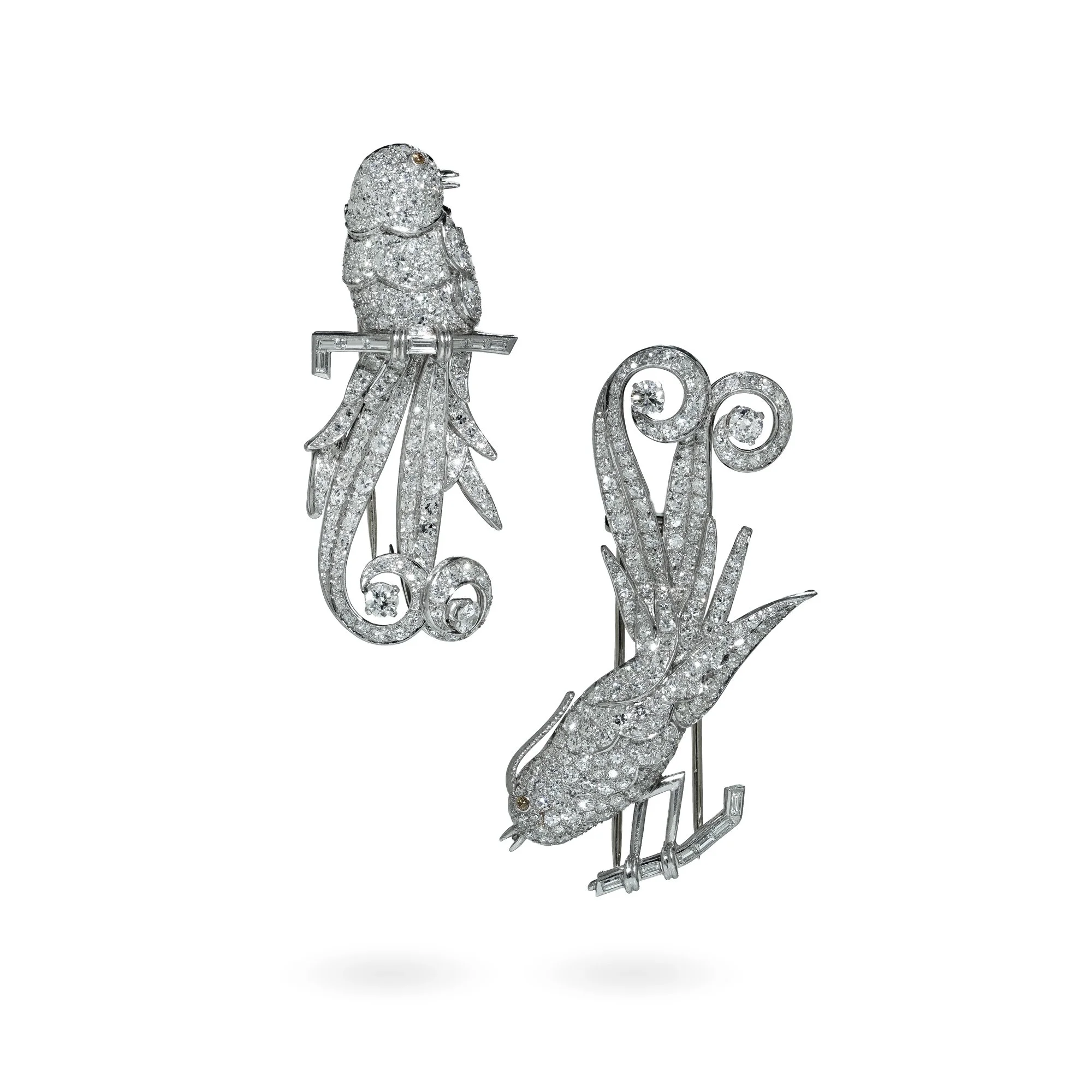
The rarest forms of a collected category. A matched pair of figural Art Deco double-clips is the form the salerooms currently chase hardest.
The signature thesis
Maison pieces carrying certified stones, where the signature underwrites demand. Signed diamond weight is the most liquid corner of the antique market — though "liquid" is always relative in jewellery.
Each is a different balance of rarity, wearability and market depth. A good dealer should be able to tell you honestly which thesis a piece belongs to — and which it doesn't.
Buying well: the short version
- Buy on the five drivers — never on weight or "age" alone.
- Insist on written authentication; certificates for important stones and pearls. (How we authenticate.)
- Prefer originality over shine — over-restored pieces are discounted by the trade even when they look perfect.
- Assume a multi-year hold; the spread makes short-term flipping a losing game for private buyers.
- Buy what you would be happy to own even if it never appreciated. At this level that isn't a consolation prize — it's the point. The dividend is wearing it.
Considering a significant purchase — or selling an important piece?
We advise privately, by appointment in Mayfair or Braintree, and we buy as well as sell. A confidential conversation costs nothing, and you will get a straight answer about which thesis a piece belongs to.
✓ Private appointments ✓ Written authentication ✓ 10,000+ items traded · 5★ rated
First look at new arrivals
Join our list to see new antique and signed jewellery before it reaches the site — one email when something worth your time arrives, nothing more.
Get first look →Explore Further
Frequently Asked Questions
Honest answers about jewellery as a store of value.
Is antique jewellery a better investment than stocks?
No — and be wary of anyone who says otherwise. It is an illiquid, income-free store of value with real transaction costs. Its advantages are different: tangibility, the pleasure of ownership, and rarity-driven resilience at the top end.
Why £10,000 as the threshold?
Nothing magic — it is roughly where the five value drivers (signatures, natural stones, rare forms) become available, and where demand is deep and international rather than casual.
Should I buy at auction instead of from a dealer?
Auction can be excellent if you can judge condition and authenticity yourself and price in roughly 30% buyer's premium with no recourse. A dealer's margin buys authentication, condition vetting and someone accountable. Different tools for different buyers.
Do I pay tax when I sell jewellery?
Possibly — jewellery is a chattel for UK CGT, so proceeds over £6,000 can attract a charge. Keep purchase records and take professional advice.
What would you never call investment-grade?
Anything abundant: ordinary vintage gold, mass-produced pieces, heavily treated stones, over-restored jewels — however pretty. Decoration is a fine thing to buy; it just shouldn't be sold to you as an asset.