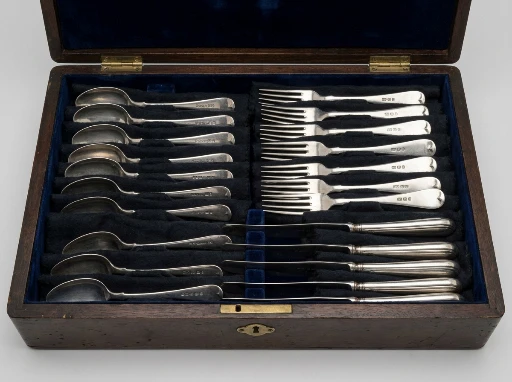
How to Read Silver Hallmarks
Turn over almost any piece of British silver and you will find a row of tiny stamped symbols. Learn to read them and you can tell, in seconds, what the metal is, the year it was tested, and the office that tested it.
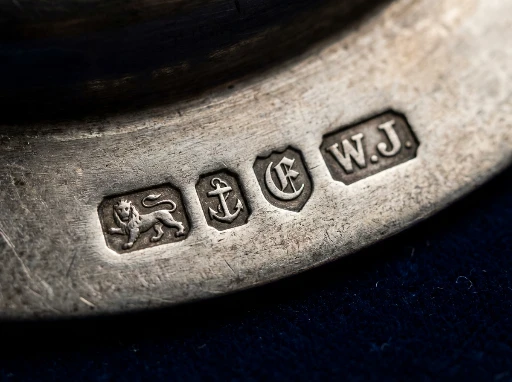
A full British hallmark is made of up to five marks: the maker, the standard (a lion passant for sterling), the assay office, the date letter, and on older pieces a duty mark. Identify the assay office first, then read the date letter against that office's own alphabet. Together they date a piece to within a single year.
If you have ever found a cluster of small symbols stamped into a spoon, a teapot or a candlestick, you have come across one of the most useful tools in the antiques world. The British hallmark is a legal guarantee of quality, applied by an independent body with no stake in the sale. Once you understand it, the marks reveal exactly what your silver is made from and when it was tested.
The United Kingdom runs one of the oldest and most thorough hallmarking systems anywhere, with roots reaching back to 1300. Whether you collect, you are new to antiques, or you have inherited a canteen of cutlery and want to know what it is, learning to read the marks is the first real step.
Key takeaways
- British silver carries up to five marks. The lion passant is the one that confirms sterling standard (92.5% pure).
- The assay office mark tells you the city of testing; the date letter tells you the year, but only once you know the office.
- A sovereign's head duty mark dates a piece to between 1784 and 1890 at a glance.
- No lion and a mark such as EPNS means electroplate, not solid silver. See our guide to EPNS vs sterling silver.
- Hallmarks confirm the metal. Value depends on maker, period, condition and rarity, which is where a specialist comes in.
What Silver Hallmarks Are
A hallmark is a series of stamps applied to precious metal by an independent body called an assay office. The marks confirm that the metal has been tested and meets a defined standard of purity. In Britain, hallmarking silver has been a legal requirement since 1363, making it one of the oldest forms of consumer protection in the world.
Without a hallmark there is no independent proof that something described as "silver" meets any standard at all. The marks remove that doubt. Each small stamp is a verified statement of fact, struck by an official body that gains nothing from the outcome.
One distinction matters from the outset. Hallmarking is not valuation. The marks tell you what the metal is. They say nothing about artistic merit, rarity or market value, and those need separate expertise.
The Five Marks Explained
A complete British hallmark can carry up to five individual marks, though older pieces often show fewer. Here is what each one means.
1. The maker's mark
This is the first mark struck and names the silversmith or firm responsible for the piece. Maker's marks are usually a set of initials inside a shaped surround, called a cartouche. The shape itself can hint at a period: a cut-corner rectangle was common in the Victorian era, while a lozenge or diamond shape points to earlier Georgian work. Reference books such as Jackson's Silver and Gold Marks let you match initials and cartouche to a named maker.
2. The standard mark
This confirms the purity of the metal. The most familiar mark on British silver is the lion passant, a walking lion in profile, which signifies sterling silver: 92.5% pure, also written as 925 parts per thousand. You may also meet:
- Britannia figure: a seated female figure for Britannia standard silver, 95.8% pure. It was compulsory from 1697 to 1720 and has been used voluntarily since.
- Lion rampant: a rearing lion used in Scotland to mark sterling assayed in Edinburgh.
- Thistle: used alongside the lion rampant on Scottish silver, particularly from Glasgow.
For more on the standards themselves, our guide to silver purity marks and the difference between Britannia and sterling silver go further.
3. The assay office mark
This symbol identifies which office tested and stamped the piece. Each UK assay office has its own distinct emblem, set out in the next section.
4. The date letter
A single letter inside a shaped shield, changed once a year by each office, lets you pin down the year of assay to within twelve months. Every office used its own alphabet sequence, typefaces and shield shapes, so you must identify the assay office before you can read the date letter correctly. A full explanation follows below.
5. The duty mark (1784 to 1890)
Between 1784 and 1890 a tax was charged on silver sold in Great Britain. The duty mark, the reigning sovereign's head in profile, confirmed the tax had been paid. Its presence dates a piece to that 106 year window even when other marks are worn. The portrait changed with each monarch, so it can narrow the date further still.
UK Assay Offices and Their Symbols
Four assay offices remain active in Britain today, each with its own town mark.
- London: a leopard's head. The oldest office, established in 1300. From 1821 the head appears uncrowned.
- Birmingham: an anchor. Established in 1773 and now the busiest office in the country by volume.
- Sheffield: a rose. Established in 1773; a crown was used until 1974.
- Edinburgh: a three-towered castle. Established in 1457.
Several offices closed during the nineteenth and twentieth centuries. Their marks help date a piece by confirming it was assayed before the office shut.
- Exeter: three castles on a shield (closed 1883).
- Chester: a sword between three wheatsheaves (closed 1962).
- Newcastle: three castles in a row (closed 1884).
- Glasgow: a tree, fish, bell and bird (closed 1964).
- Dublin: a crowned harp, later a Hibernia figure (still operating, with its own Irish tradition).
If your piece bears a closed-office mark, you know at once that it predates that closure, which is useful when other marks are partly worn.
Found a mark you cannot place?
Send us a clear photo of the marks. We read British hallmarks every day and will identify them at no charge.
How to Read the Date Letter
The date letter is the most powerful mark for collectors and valuers. Each office worked through part of the alphabet over a cycle of roughly 20 to 25 years, then changed the shield shape and typeface before starting again. Letters such as J, V, W, X, Y and Z were usually skipped to shorten the cycle.
To read a year from a date letter you need three things: the letter, the typeface (Roman capital, italic, Old English and so on), and the exact shape of the shield around it. Combined with the assay office mark, those three elements point to a single year on a date-letter table.
The standard printed reference is Jackson's Silver and Gold Marks of England, Scotland and Ireland, revised by Ian Pickford, and several reliable databases let you search online. Remember that the date letter records the year of assay, not manufacture. A piece finished in late autumn might be assayed the following January, so the letter and the true year of making can differ by a few months.
Testing Whether Silver Is Genuine
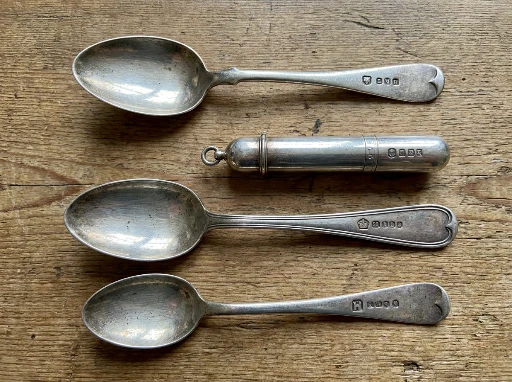
Beyond reading the marks, a few practical tests help confirm genuine sterling silver. None is conclusive alone, but together they build a clear picture. Our dedicated guide on how to tell if silver is real covers these in more depth.
The magnet test
Silver is not magnetic. Hold a strong neodymium magnet near the piece. If it pulls, the item is not silver or has a ferrous core under plating. It is a useful first check, though many non-silver metals are also non-magnetic.
The ice test
Silver has the highest thermal conductivity of any metal. Rest a small ice cube on the surface. If it begins to melt almost at once, that rapid heat transfer points strongly to genuine silver. Plated items on a base-metal core will not show the effect nearly as clearly.
The marks themselves
A clearly struck, correctly formed set of hallmarks is strong evidence of authenticity in its own right. Forging convincing British marks is difficult, and under the Hallmarking Act 1973 it is a criminal offence to apply false marks or to sell counterfeit-marked goods as genuine hallmarked silver.
Sterling Versus Silver Plate
Silver-plated articles are made from a base metal, usually copper, brass or nickel silver, with a thin layer of silver applied by electrodeposition. They never carry a sterling hallmark. Instead you may see marks such as the following:
| Mark | What it means |
|---|---|
| Lion passant | Solid sterling silver, 92.5% pure throughout |
| EPNS | Electroplated nickel silver (plate on a nickel base) |
| EP / EPBM | Electroplate, often on Britannia metal |
| A1 | A quality grade used by platers, not a silver standard |
Plated items carry little or no intrinsic silver value, though some makers of decorative Victorian and Edwardian wares are collected in their own right. Sterling silver, by contrast, is 92.5% pure throughout the whole piece, and its hallmarks are the independent proof of that.
Selling Hallmarked Silver
If you have identified a piece of hallmarked silver, from a single spoon to a full tea service, and want to understand its current value, a specialist assessment gives a far more accurate figure than an online calculator or a general dealer.
Value rests not only on weight and purity but on the maker, the period, the condition, rarity and any notable provenance. A Mappin & Webb tea set in fine condition, a Georg Jensen piece, or a rare canteen by a London maker will all command prices well beyond melt. Our guides to antique silver tea services and Paul Storr and Regency silver show how much maker and period can matter.
At Mozeris Fine Antiques our specialists offer free, no-obligation valuations on British hallmarked silver of every period, from Georgian candlesticks and Victorian canteens to Edwardian dressing-table sets. We pay competitive prices with same-day payment at our Mayfair and Braintree showrooms, or by post.
Frequently Asked Questions

Faustas has over ten years' experience in antique silver and jewellery, specialising in Georgian, Victorian and Regency pieces. He works with private clients and estates from the Mozeris showrooms in Mayfair and Braintree, Essex.
Have Silver You'd Like Valued?
Send us a few photographs, including the hallmarks, and our specialists will give you an honest, no-obligation assessment. Free valuation, same-day payment, showrooms in Mayfair and Braintree.
Thinking of Selling Antique Silver?
Mozeris Fine Antiques are specialist buyers of antique and sterling silver. Send us photographs — including the hallmarks — for a free, no-obligation valuation. Payment on agreement.
📍 47 Maddox Street, Mayfair · Braintree, Essex · 📞 01376 334 482 · Strictly by appointment