How to Date a Pocket Watch: Eight Clues, the Hallmark and the Serial Number
How old is my pocket watch? Eight clues you can read yourself, then what the serial number can and cannot tell you, depending on where the watch was made.
To date a pocket watch, read the case marks first, then the winding, movement and dial:
- British case: the hallmark date letter gives the year the case was assayed.
- Key or crown: key winding was the norm until the 1870s; English fusee watches kept it until about 1900.
- American watch: the movement serial dates it through the maker's published lists.
- Swiss or English: no public list. Patek Philippe, Longines and Omega search their archives; English watches are dated by the hallmark.
- A date is not a value: metal, maker, condition and originality set the price.
In this article
- How old is my pocket watch? Start with three questions
- The dating checklist: eight clues, in order
- Pocket watch serial number lookup: it depends where it was made
- Pocket watch value by serial number: what a serial cannot tell you
- Putting it together: a watch we handled
- Free dating and valuation, selling and buying
- Questions
How old is my pocket watch? Start with three questions
Most pocket watches can be dated to within a decade from the outside and the back, and many to a single year. Before you look anything up, answer three questions:
- Where was it made?
English, Swiss or American. It decides whether a serial number will help at all, and the answer is often written on the movement.
- What is the case made of?
A gold or silver case assayed in Britain carries a date letter, the single most exact clue there is.
- Key or crown?
A watch wound with a key belongs to an earlier world than one wound through the crown.
The chart shows when the main clues were in use. The checklist below then takes them one at a time.
Main periodEarlier form or fading out
The dating checklist: eight clues, in order
Work down the list. The first clue that gives a firm date wins; the others confirm it, or warn you that a case, dial or movement has been changed.
Case hallmarks: the most exact date on a British watch
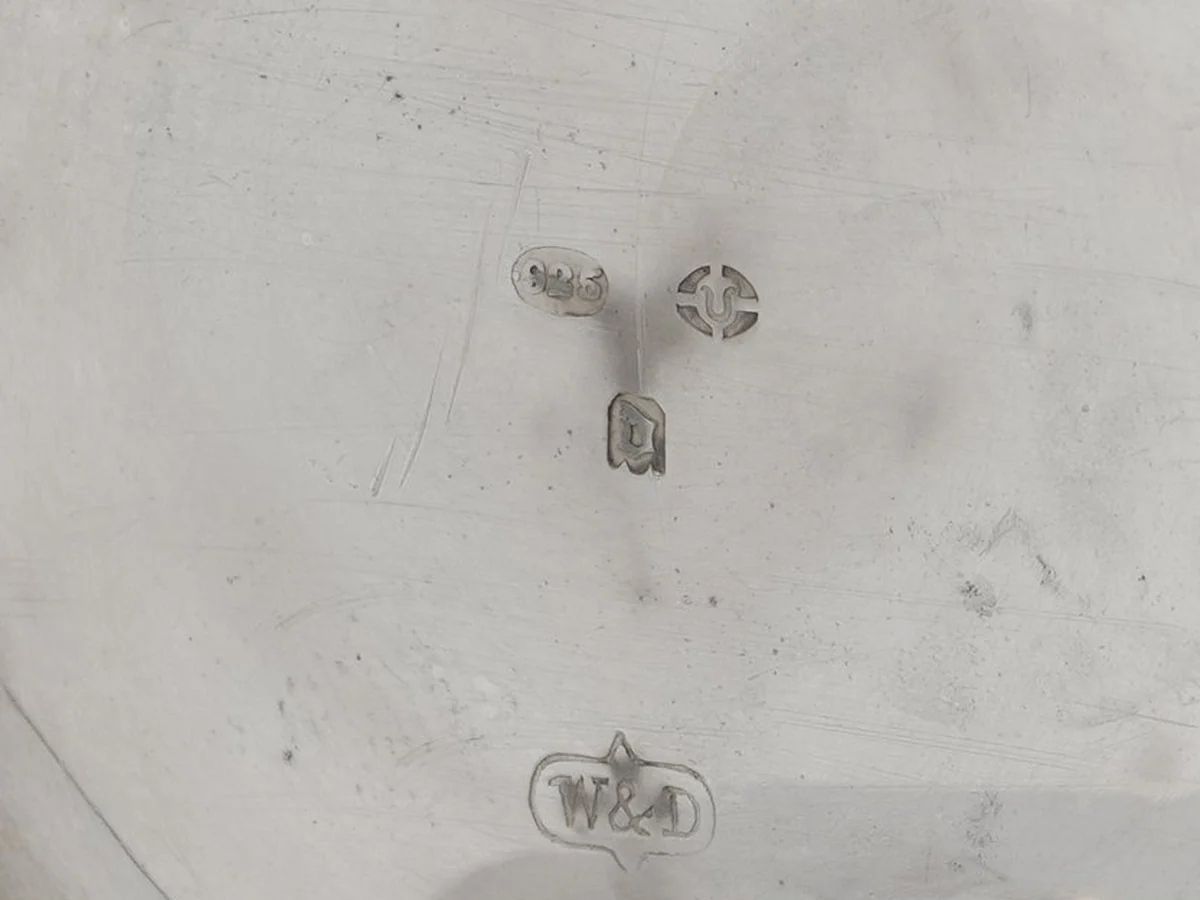
A gold or silver case assayed in Britain carries a standard mark, a town mark, a sponsor's mark and a date letter that gives the year of assay. On an English watch it is the best date you will get.
Foreign watches sold here carry one too: from 1888 imported cases had a composite mark with the word Foreign, and from 1 June 1907 their own import marks, with each office's normal date letter.
The hallmark dates the case, not the movement. Letter tables are in our pocket watch hallmarks guide; initials are decoded in case makers' marks. For gold wristwatches, see how to date a vintage gold watch.
Key wind or crown wind
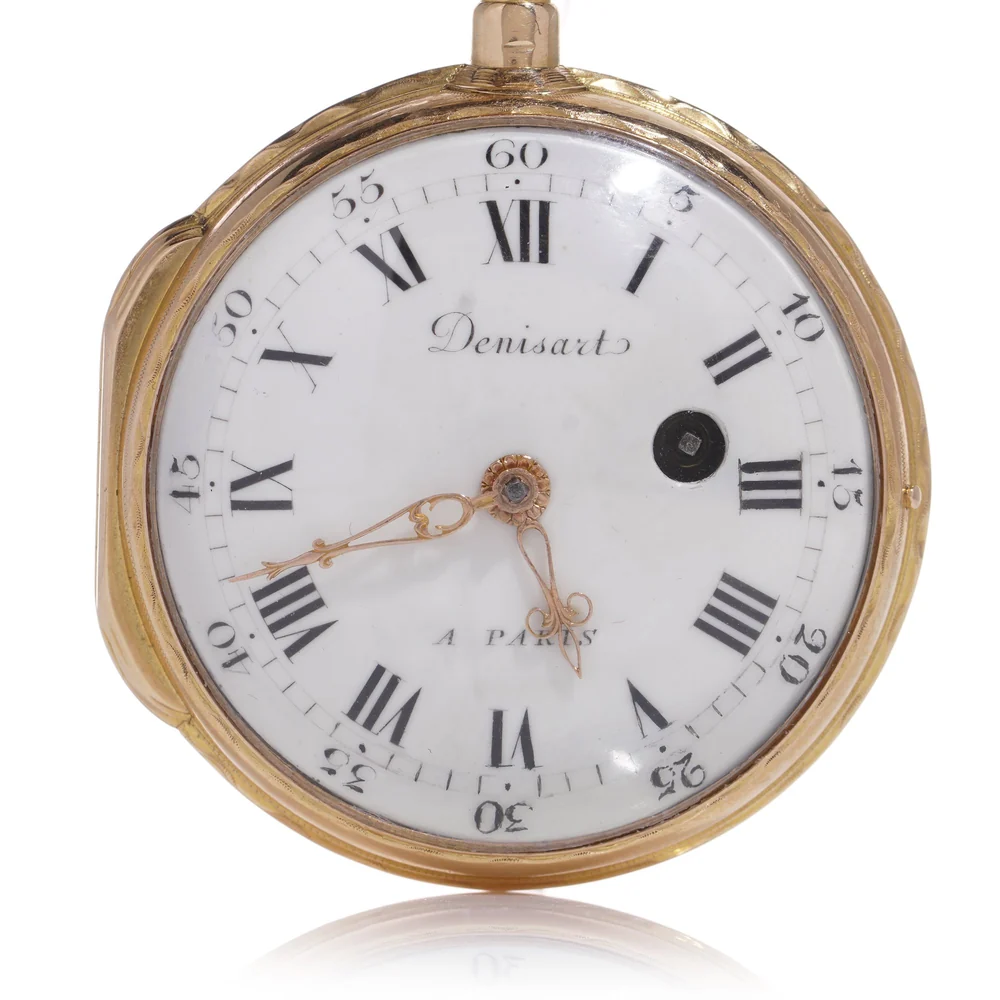
Look for a small round hole in the dial or in the inner back. Until the third quarter of the 19th century most pocket watches were wound and set with a key.
Winding through the crown came from Adrien Philippe, later of Patek Philippe, who patented it in 1844 and 1845. Stem winders were on sale at the Great Exhibition of 1851, and Elgin made its first in 1873. English makers kept the key wound fusee longest, until about 1900.
So a key winder from Switzerland or America is usually older than the 1880s, but an English one can be as late as the 1890s. Pin set and lever set were being dropped for stem set by the 1920s. See how to wind and set a pocket watch.
Two cases, one inside the other
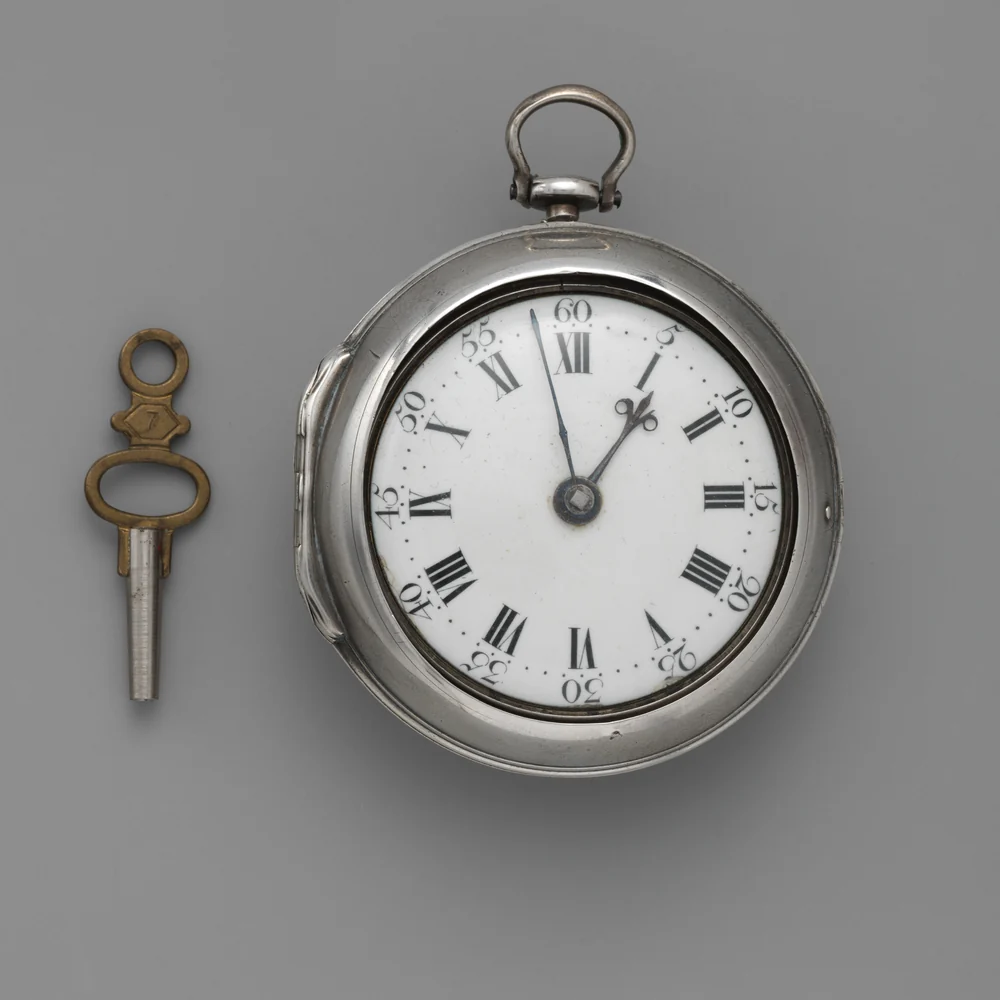
A pair-case watch has a plain inner case that holds the movement and a separate outer case it drops into, often with a printed watch paper tucked between them.
It is the classic form of the late 17th and 18th centuries. The Metropolitan Museum's pair cases run from a Tompion of 1682 to 1683 to a watch by S. I. Tobias of 1824 to 1825. A pair case points to the 1700s or the early 1800s.
For the movements and watch papers inside them, see verge fusee pocket watches.
Dial and hands
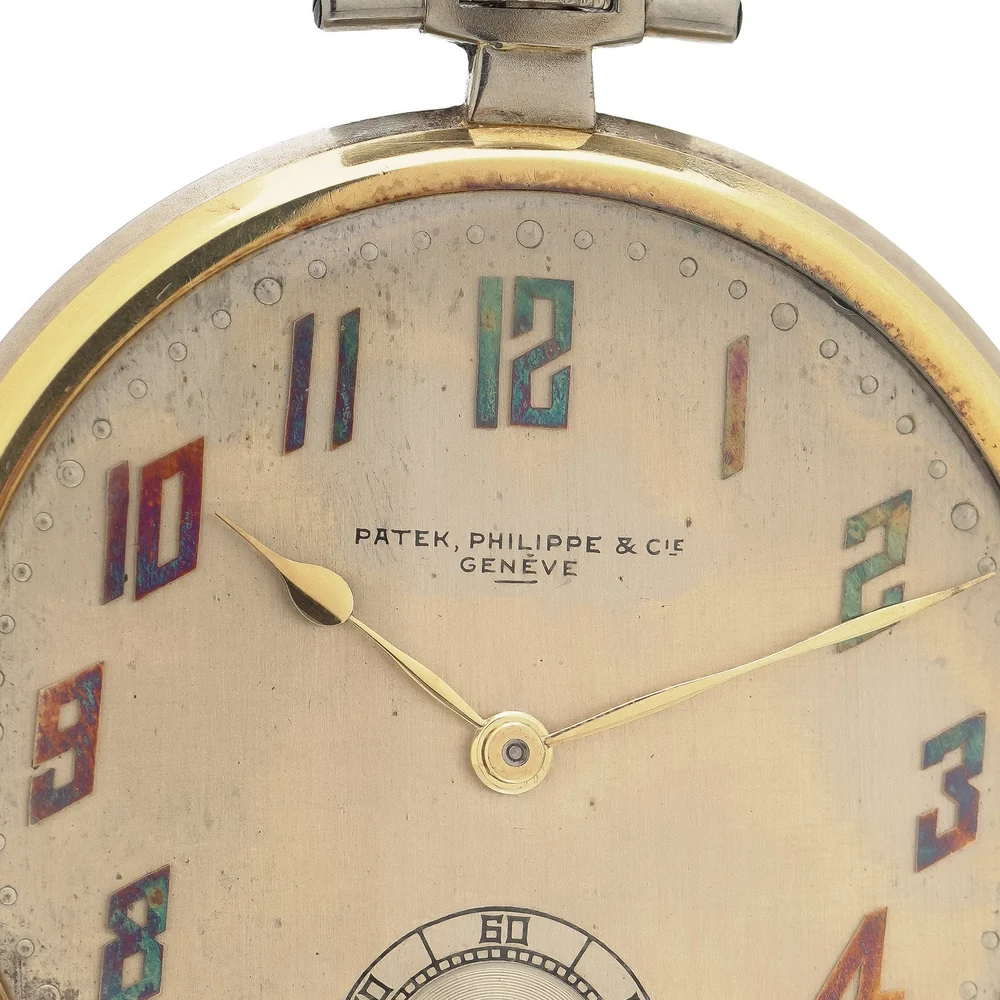
Dials follow fashion, which makes them a useful cross-check rather than proof.
- Breguet hands, with a hollow moon tip, date from about 1783. They fell out of favour in the late 1800s and came back around 1930.
- Luminous numerals are 20th century: radium paint went mainstream on Ingersoll's Radiolite watches from 1916, and tritium replaced it in the 1970s.
- Replaced dials are common. A dial that looks newer than the case is a warning, not a date.
For the names of hand styles, see our guide to watch hands.
Movement layout: full plate, three-quarter plate or bridges
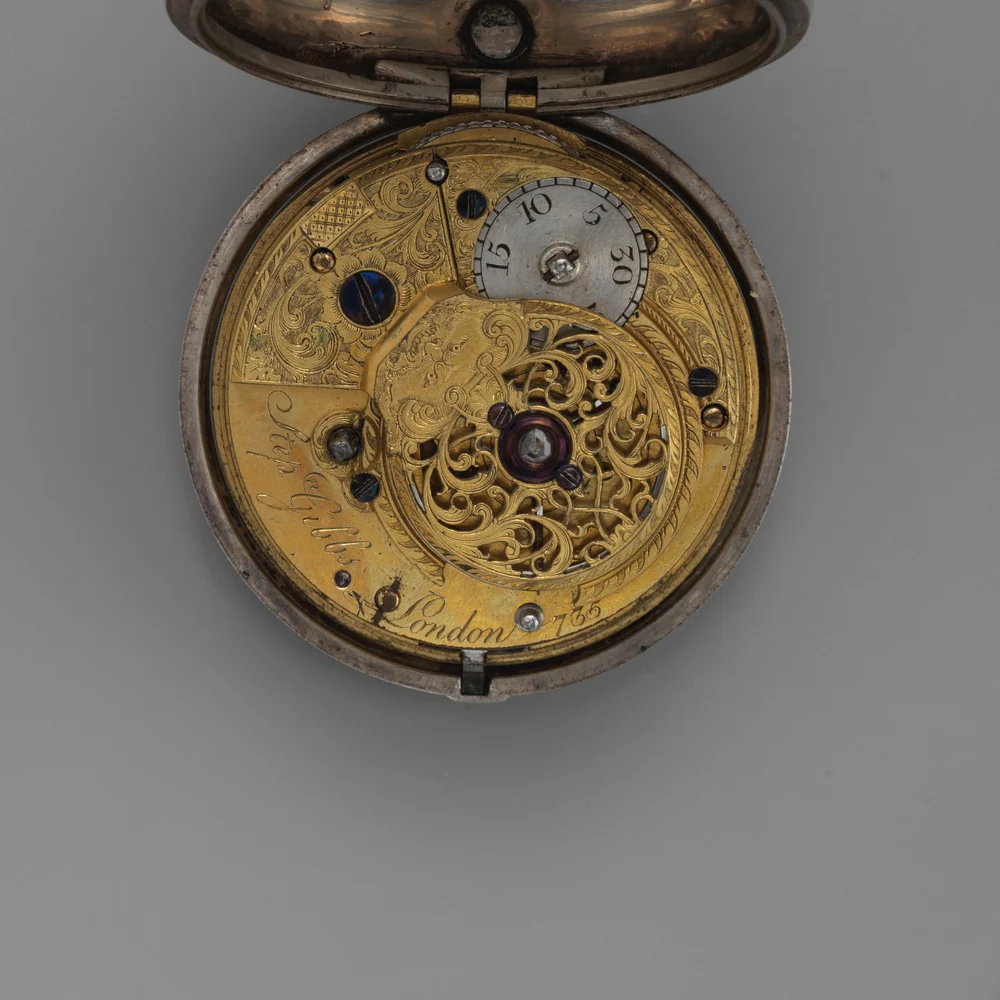
Open the back (how to open a pocket watch) and look at how the top of the movement is built.
- Full plate. One round plate covers the wheels, with the balance on top under a cock. It is the English and early American construction: Elgin's first watch of 1867 was full plate. With a fusee chain inside, it is the oldest layout you will meet.
- Three-quarter plate. Part of the top plate is cut away so the balance sits level with it, for a thinner watch. It is an English construction, later copied at Glashütte.
- Bridges. Separate bars hold the wheels. Jean-Antoine Lépine of Paris devised the layout around 1764 to 1765, dropping the top plate and the fusee to make thinner watches.
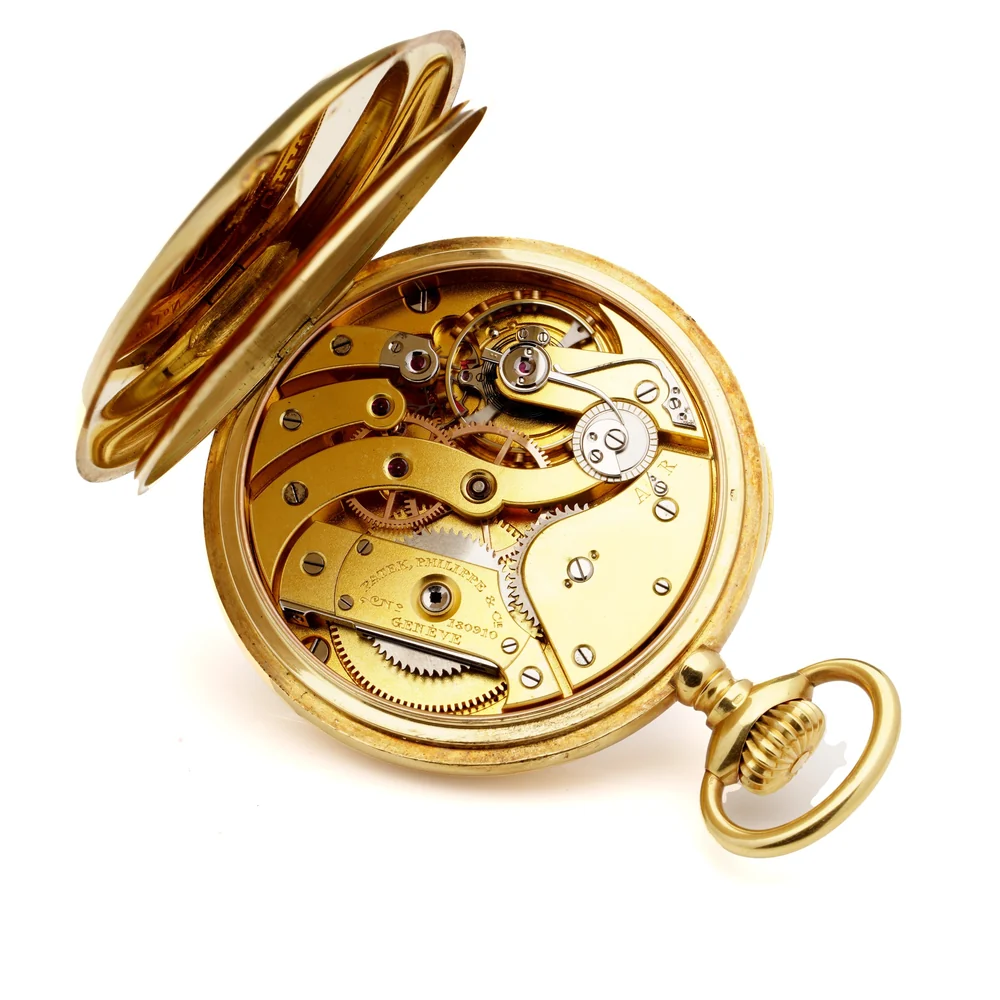
Bridges, crown winding, no chain
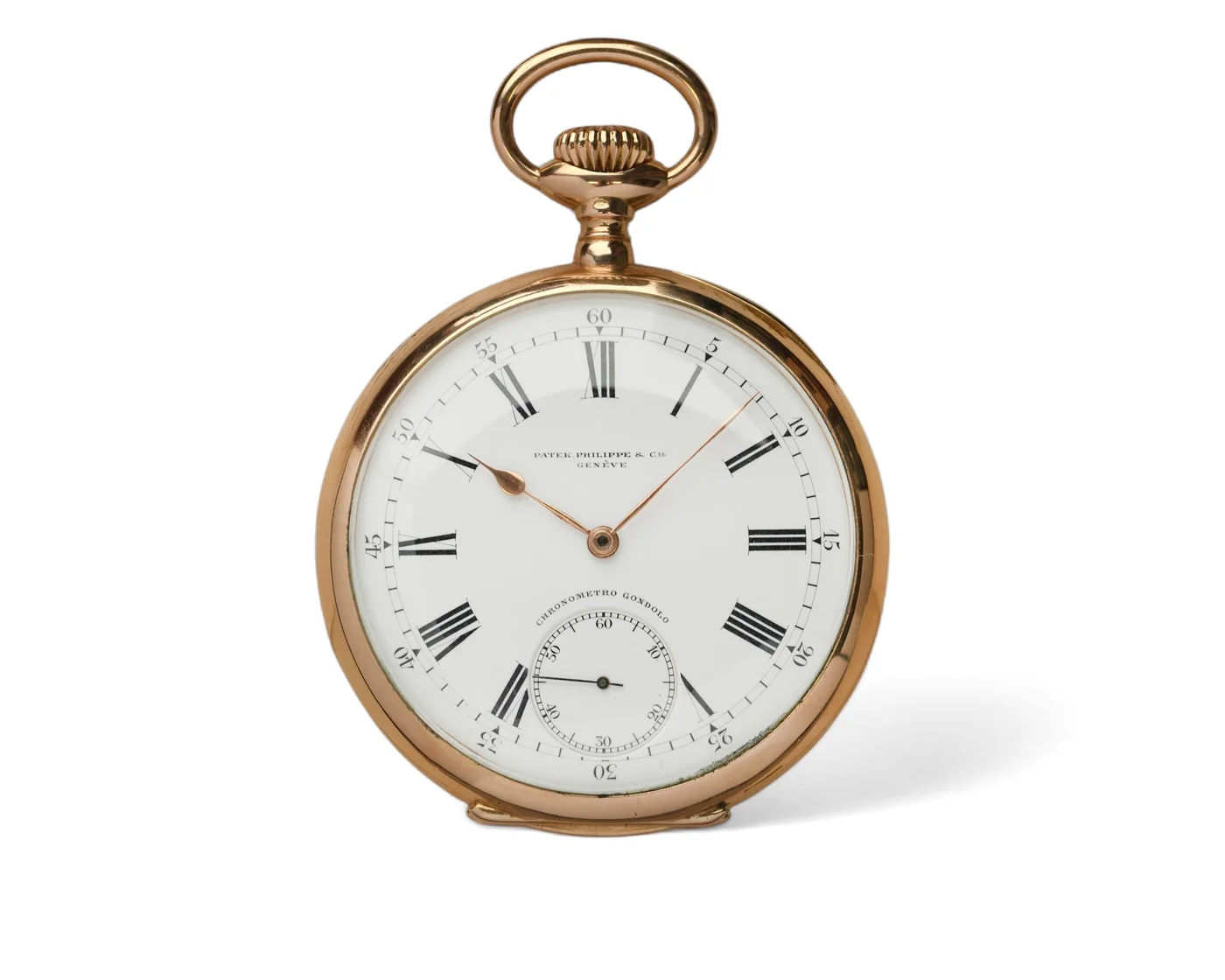
Compare the two movements. On the Patek Philippe each wheel sits under its own bridge and the balance works in the open. There is no full top plate, no fusee chain and no winding square for a key.
The Gibbs watch dates from 1770. This one was made in the early 20th century, in the years Patek Philippe supplied Gondolo & Labouriau.
Jewel count
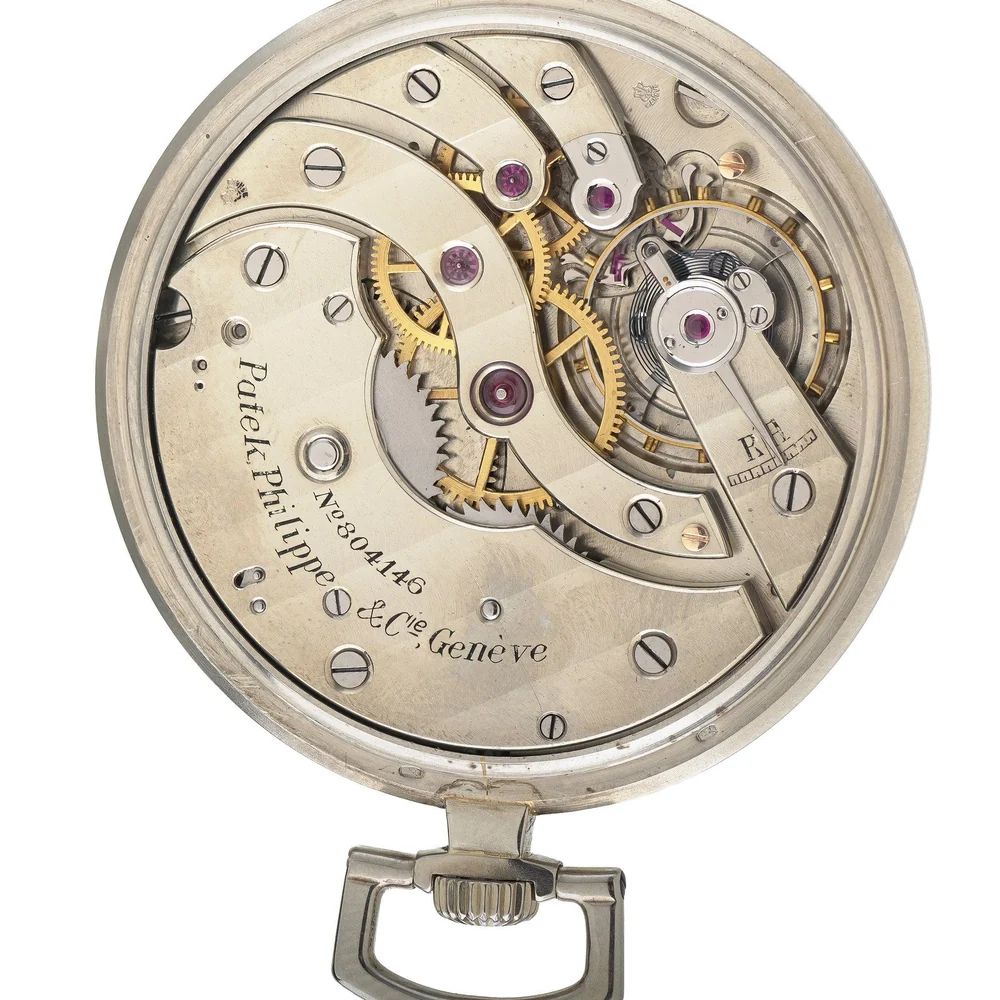
Jewels are rubies used as bearings. They were patented in England in 1704 by Nicolas Fatio de Duillier and Peter and Jacob Debaufre, and became cheaper after Auguste Verneuil's synthetic ruby process of 1902.
A fully jewelled time-only watch has 17. The American railroad standards adopted after 1893 asked for at least 17 jewels, an open face and 16 or 18 size.
American movements usually have the count engraved; on others, count the red stones you can see. A count says more about grade than date, and an American serial lookup gives the grade, so you can check the two agree. Grades are explained in our Waltham and Elgin guides.
Maker and retailer names
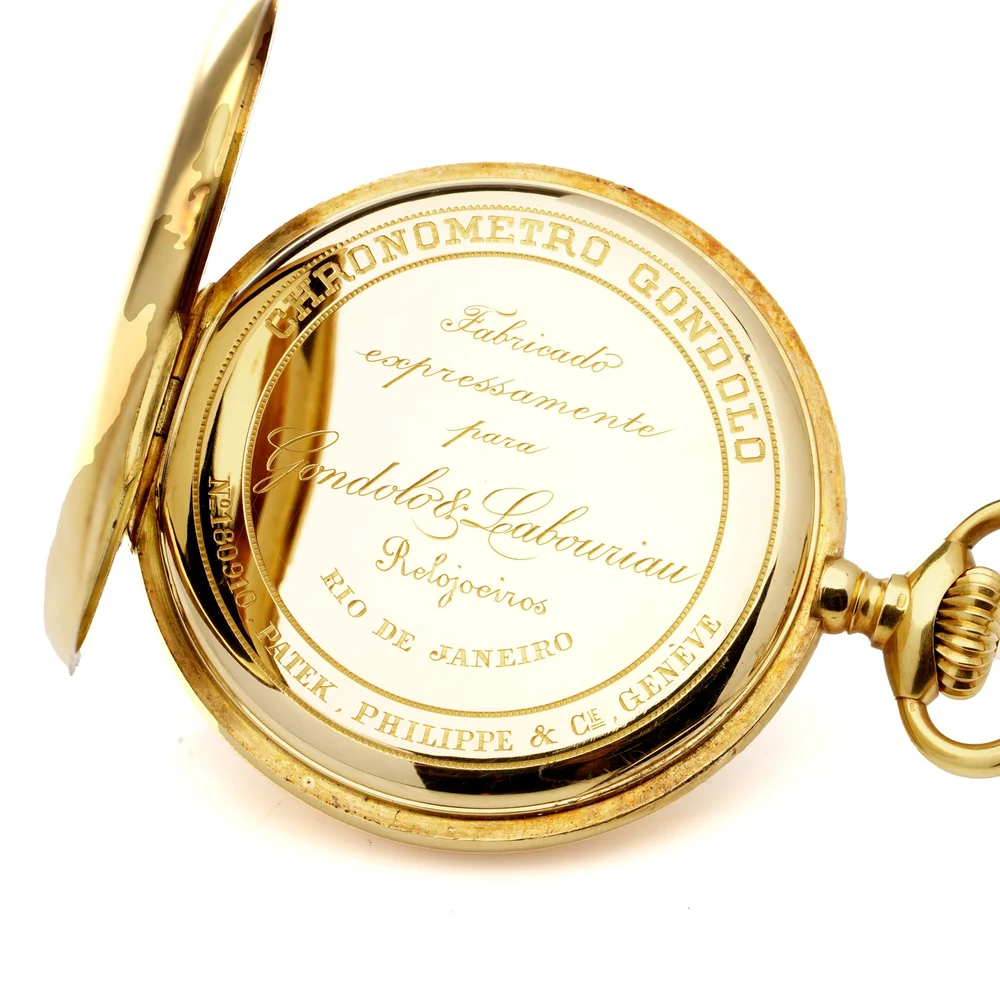
The name on the dial is often the shop that sold the watch, not the firm that made it. A name with known trading years gives you a window.
Patek Philippe made its Chronometro Gondolo watches for one retailer, Gondolo & Labouriau of Rio de Janeiro, for nearly thirty years. The last of the series left Geneva in 1927, so that name dates a watch to 1927 or earlier.
Wilsdorf & Davis was founded in London in 1905, registered the name Rolex in 1908 and became the Rolex Watch Co. in November 1915. A watch marked W&D falls between those dates. See our vintage Rolex guide and Patek Philippe guide.
Patent dates, inscriptions and quality marks
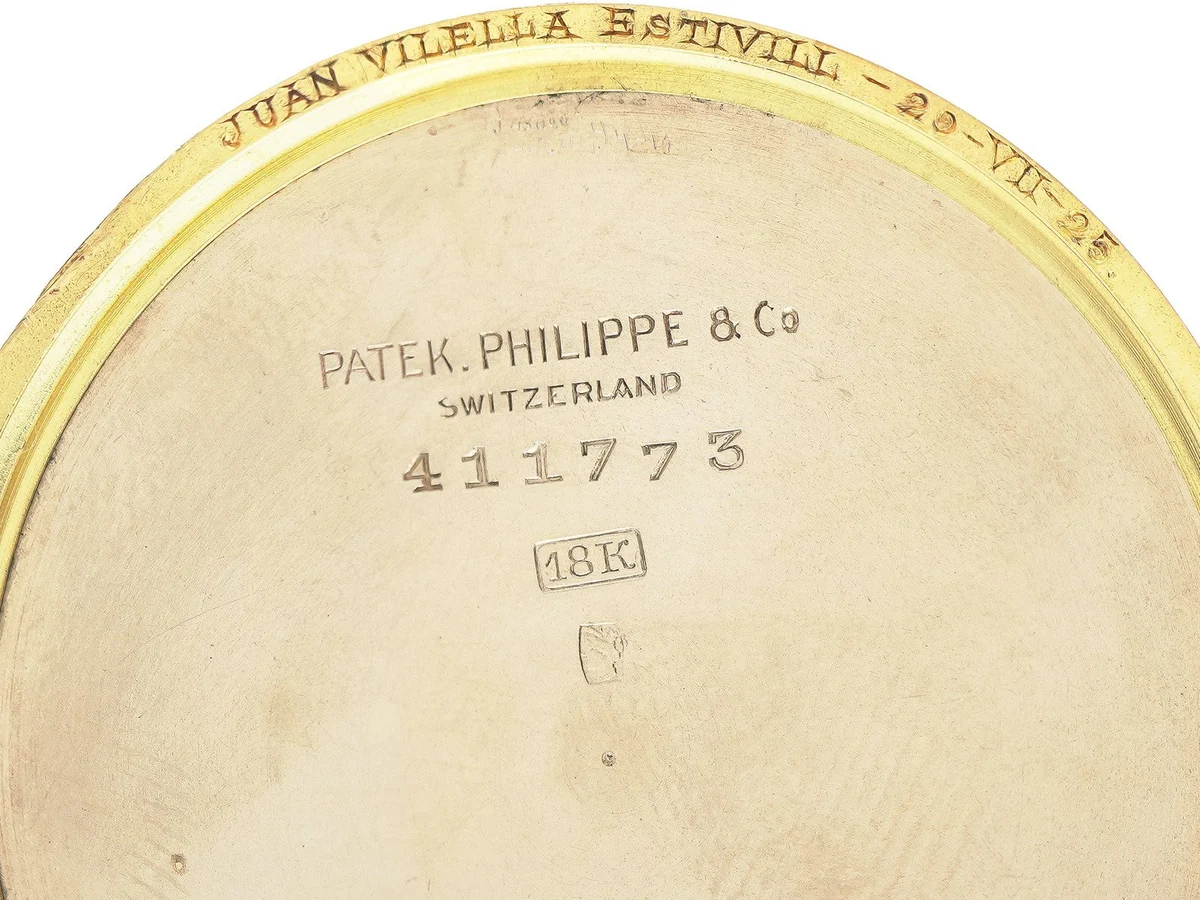
- A patent date on a movement or case gives the earliest possible date. The watch was made after it, sometimes long after.
- A dated inscription gives a point the watch existed by. Ours reads 29 VII 25: it was in its owner's hands by July 1925.
- Swiss marks. The Geneva Seal on a movement means it was made after the law of 6 November 1886; Swiss Helvetia and squirrel gold marks appear from 1882.
- Scratched numbers inside the back are watchmakers' service marks, not the date the watch was made: see case makers' marks.
Two quicker checks
- Case style. Hunter, half hunter and open face cases were made side by side for most of the 19th and early 20th centuries, so the style alone rarely dates a watch. The American railroad standards of 1893 asked for open faces. See full hunter, half hunter and open face.
- Thickness. Bridge and three-quarter plate movements made thinner watches possible. A very thick, key wound watch with a fusee is the early English type.
Pocket watch serial number lookup: it depends where it was made
The serial number is on the movement, under the case back or dust cover. The number stamped in the case is a separate series; the difference is explained in case makers' marks.
American watches: published serial lists
American factories numbered their movements in running series and kept production records, so collectors have rebuilt year tables from them. PocketWatchDatabase holds the lists for the American makers and gives the grade, jewel count and size from a serial.
| Maker | Pocket watch years | Where to look up the serial |
|---|---|---|
| Waltham | 1850s to 1957 in the US | Our Waltham guide has the year table |
| Elgin | 1867 to 1968 | Our Elgin guide has the year table |
| Hamilton | First watch 1893, Lancaster, Pennsylvania; US factory closed 1969 | PocketWatchDatabase |
| Illinois | Springfield, from 1870; bought by Hamilton 1927 to 1928; US output ended by the mid-1930s | PocketWatchDatabase |
| South Bend | 1905 to 1929, nearly a million watches | PocketWatchDatabase |
Swiss watches: archive extracts from the great houses
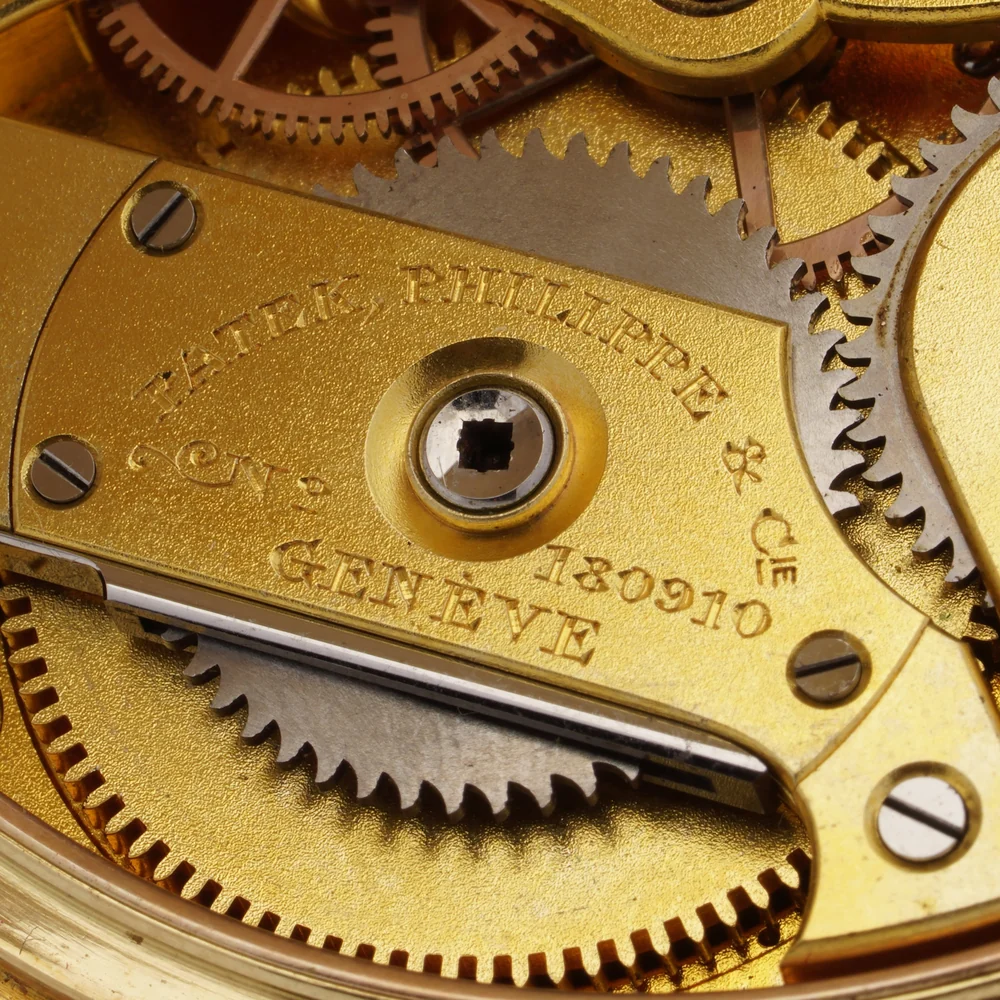
Swiss makers did not publish year lists in the American way, but the great houses kept ledgers by serial number and will search them for you.
Send both the movement number and the case number, with photographs. An extract gives the year of manufacture and often the date and place of first sale.
| House | Records kept since | What you get |
|---|---|---|
| Patek Philippe | 1839 | Extract from the Archives: movement and case numbers, date of manufacture and of sale. First sale must be over 10 years ago; CHF 500 when we checked in October 2026 |
| Longines | 1867 | Extract from the archives for watches over 10 years old, free of charge; send the 5 to 8 digit serial and photos |
| Omega | Production records in Biel | Extract from the Archives: production date and how the watch left the factory, for watches over 10 years old; CHF 120 plus VAT when we checked |
A minor or unsigned Swiss watch has no archive. Date it by its case: Swiss gold marks from 1882, British import marks from 1888 and 1907, and the style clues above. See our Longines and Omega guides for those makers.
English watches: no serial database, so read the hallmark
English makers numbered their own work, like the 765 on Stephen Gibbs's watch above. Each number belongs to one workshop's sequence, and there is no central list to look it up in. That is why a search for a UK pocket watch serial number lookup finds nothing useful.
The hallmark does the job instead: find the date letter and look it up in our pocket watch hallmarks tables.
Many watches in British drawers are American or Swiss movements in British hallmarked cases. Date the movement by its maker's list or archive and the case by its hallmark. The two should be close; if they are decades apart, the watch has been recased.
Pocket watch value by serial number: what a serial cannot tell you
A serial number gives a date and, for an American watch, a grade. It does not give a value, and a site that promises one from the number alone is guessing.
- Case metal and weight. Solid gold, gold filled, silver or base metal: the serial says nothing about the case, which was often made by another firm.
- Condition. A cracked enamel dial or a broken balance staff changes the price.
- Originality. A movement recased, or with a replacement dial, is worth less.
- Maker and complications. A repeater or chronograph is a different market.
- Whether it runs, and any box, papers or provenance.
For real prices by type, see our pocket watch value guide, and for striking watches our repeater guide.
Dated your watch? Get a free quote
Putting it together: a watch we handled
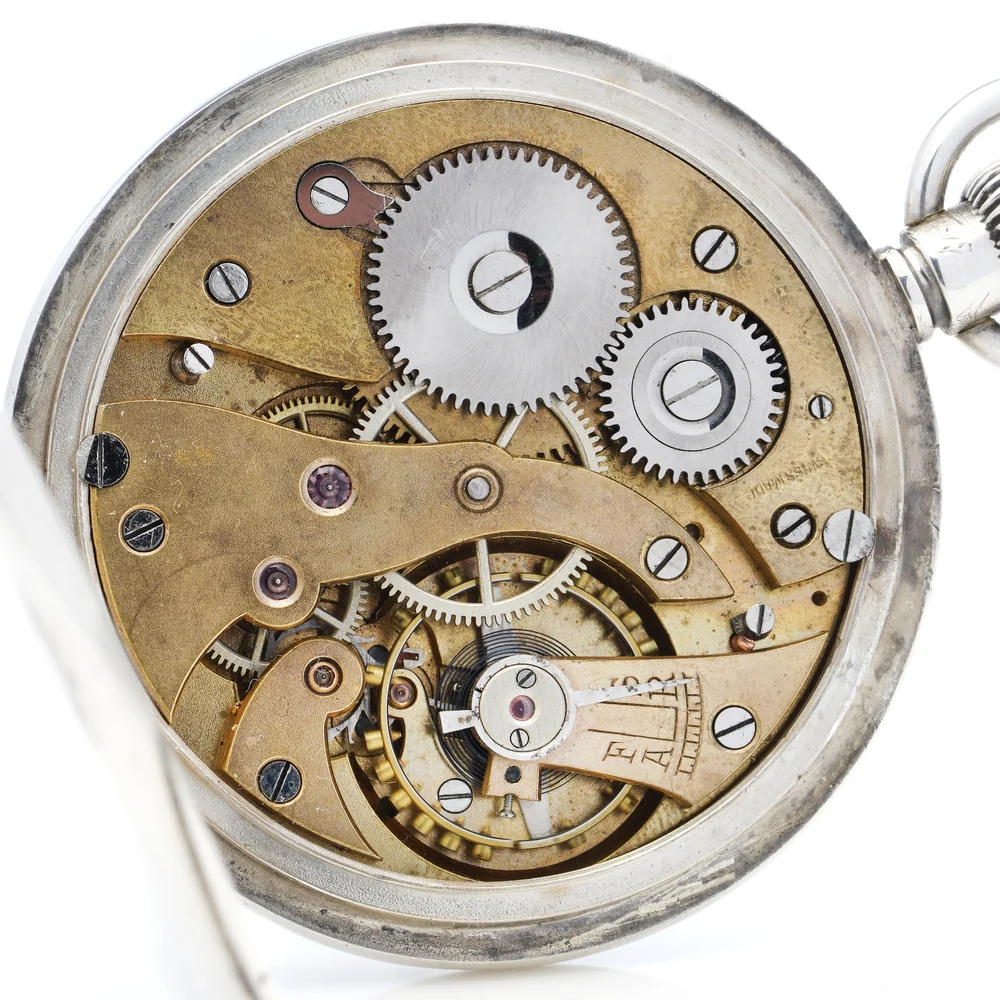
A Wilsdorf & Davis open face watch
- Case: sterling 925 in an oval with an import town mark, so a foreign case assayed in Britain after 1 June 1907.
- Sponsor's mark: W&D, the London firm that traded under that name from 1905 to November 1915.
- Movement: a Swiss lever with bridges, wound and set through the crown.
Together they place the watch between 1907 and 1915. The date letter in the case back narrows it to a single year.
Free dating and valuation, selling and buying
We date and value pocket watches from photographs, free and without obligation. Send:
- Photograph
The dial, the movement with any serial number, the marks inside the case back, and the crown or winding hole.
- Send
Use the form below, call 01376 334482 or WhatsApp us. See also selling your pocket watch.
- Visit
Bring it to 47 Maddox Street, Mayfair (by appointment) or to Braintree, Essex. Contact us to book.
Buying? See the antique pocket watches in our collection now, or all our watches.
Request a free valuation
- Start with the case: a British hallmark date letter gives the year of assay.
- Key winding, a fusee, a pair case and a full plate movement all point to an early watch.
- American serials look up by year; Patek Philippe, Longines and Omega offer archive extracts; English watches have no serial database.
- A serial gives a date, not a value; we date and value pocket watches free from photos.
Questions we are asked
How do I find out how old my pocket watch is?
Read the hallmarks inside a British gold or silver case first: the date letter gives the year the case was assayed. Then check whether it winds with a key or the crown, look at the movement layout, and for American and some Swiss watches look up the movement serial number.
Can I look up a pocket watch serial number in the UK?
Not for English watches: there is no central serial database, because each maker numbered his own work. English watches are dated by the hallmark date letter. American serials can be looked up, and Patek Philippe, Longines and Omega search their archives on request.
Where is the serial number on a pocket watch?
On the movement, under the case back or inner dust cover. The number stamped inside the case is a separate case number.
Does the serial number tell me what my pocket watch is worth?
No. It gives a date and, for American watches, a grade. Value depends on the case metal, maker, condition, originality and whether it runs.
How old is a key wind pocket watch?
Usually older than the 1880s for Swiss and American watches. English makers kept key wound fusee watches until about 1900.
How can I tell if my pocket watch is over 100 years old?
A hallmark date letter before 1926, a key winding hole, a fusee chain, a pair case or a full plate movement all point to a watch made more than a century ago.
Do Swiss pocket watches have serial numbers?
Yes, on the movement, but most Swiss makers never published lists. Patek Philippe, Longines and Omega will search their archives for a fee or free; other Swiss watches are dated by their case marks and style.
When did people stop carrying pocket watches?
Wristwatches began to replace them around the First World War, when officers found a watch on the wrist easier to read. Pocket watches were still made for decades after.
Date and value your pocket watch
Send photos of the dial, movement and case marks for a free dating and valuation, or visit us in Mayfair or Braintree.
- We buy directly
- Free valuation from photos
- Appointments in Mayfair and Braintree
- Insured postage or collection
New pieces reach our list first: join the Mozeris list.