What Is the Oldest Wax Seal?

Wax seals have long been symbols of authenticity, authority, and confidentiality. Used to secure and verify the integrity of important documents, these small marks of melted wax have left a significant imprint on history. But just how far back can we trace the use of wax seals? Let’s explore the origins of this ancient practice and uncover the oldest known wax seal in history.
The Oldest Wax Seal: Tracing Its Origins
The earliest known use of wax seals dates back to ancient China, during the Shang dynasty (c. 1600 – c. 1046 BC). These early wax seals, called "yìn," were used primarily by officials to authenticate letters and documents. The use of a seal in place of a signature helped ensure that the document was both genuine and untampered, providing a crucial layer of security in official communications.
Why Wax?
While various materials were used for seals over time, including clay, stone, and lead, wax eventually became a preferred medium because of its malleability and ease of use. Wax could be easily molded, melted, and imprinted with intricate designs or symbols, which made it perfect for verifying authenticity. Wax was also relatively inexpensive, making it a practical choice for sealing documents.
The Role of Seals in Ancient China
In ancient China, wax seals were highly regarded symbols of authority. They were not just limited to verifying written correspondence; they were also used to mark ownership, provide official approval, and secure storage containers like chests and envelopes. The Shang dynasty’s use of wax seals set a precedent for the way seals were used in other parts of the world in later centuries.
Wax Seals Beyond China
Though the oldest wax seals originated in China, other ancient civilizations developed similar practices. For instance, the Mesopotamians used clay seals as early as 3500 BC to stamp official documents and ownership on goods. However, the method of using wax, rather than clay, gained more widespread popularity in Europe during the medieval period, when wax seals were frequently used by kings, bishops, and nobility to authenticate official decrees and correspondence.
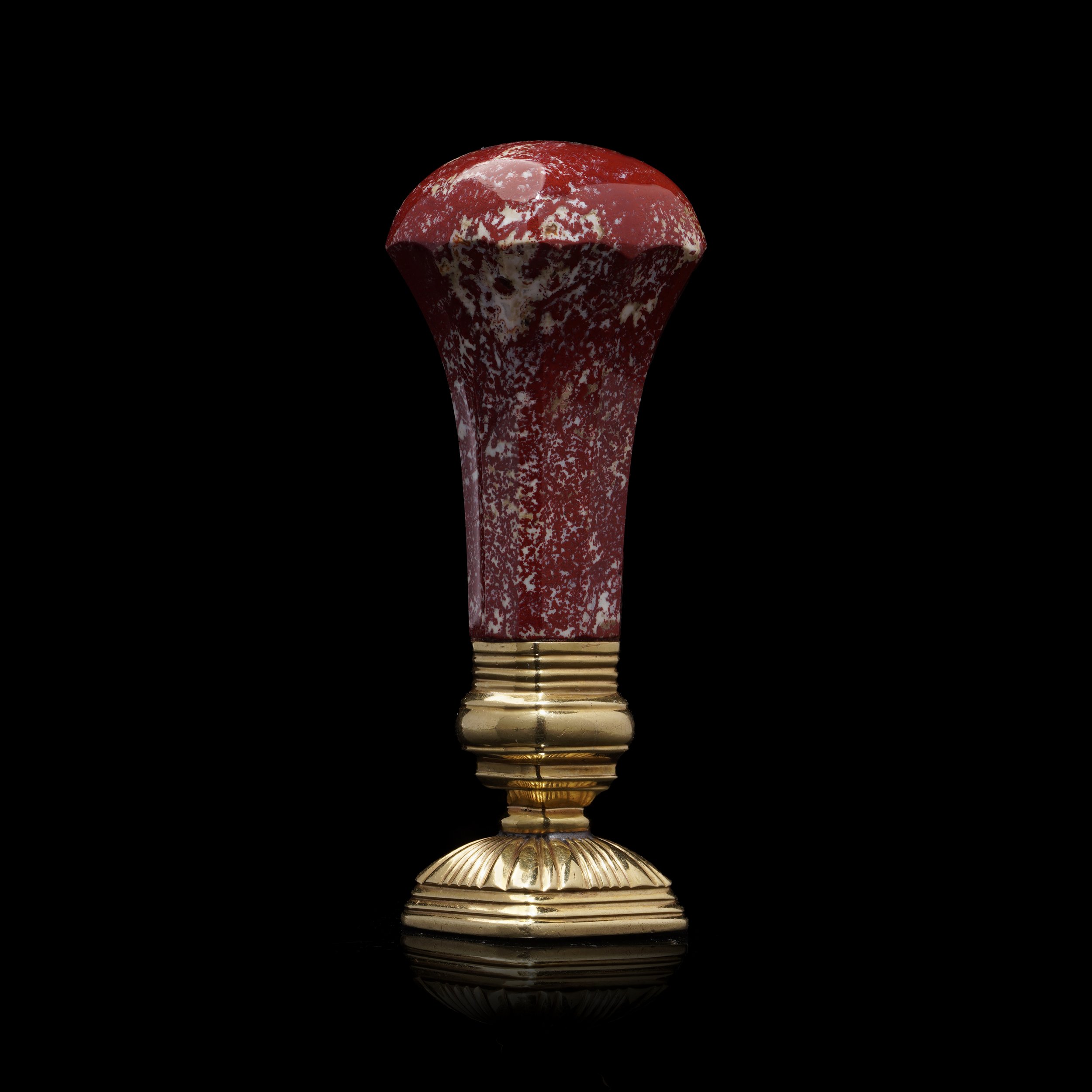

19th century 15KT gold seal, the rectangular chalcedony face carved in intaglio with the portrait of a young man in classical profile, below a richly chased gold handle and suspension ring.
The portrait is cut in the manner of an antique gem, the head turned to the right with close curling hair and a bare shoulder, so that a wax impression gives a crisp cameo of the same profile. The handle rises from a fluted stepped base through a band of chased acanthus to a scrolled loop, and the whole was made to hang from a watch chain.
Dimensions -
Height: Approximately 4 cm
Width: Approximately 2 cm
Depth: Approximately 1.7 cm
Weight: 15.5 grams
Specifications -
Period: 19th century
Metal: 15KT gold
Seal: Chalcedony intaglio, classical male portrait
Handle: Chased foliate, fluted stepped base, suspension ring
Condition :
Very good antique condition. The intaglio carving is crisp. Light wear to the high points of the chasing consistent with age.