Art Deco Silver: A Guide to 1920s and 1930s Pieces
The geometric forms, cocktail silver and cigarette cases of the interwar years sit in a distinctive corner of the antique market. Here is how to identify the period, spot the good pieces, and understand what they realistically sell for.
Art Deco silver runs from roughly 1919 to 1939 and favours clean geometric forms over Victorian ornament. The strongest values sit with matched sterling tea services by known makers (often £400 to £1,200) and fine enamel cigarette cases. Plain engine-turned cases are abundant and modest, typically £60 to £150. Always confirm sterling hallmarks first, because a great deal of "Deco silver" is in fact electroplate.
Art Deco silver occupies a genuinely appealing corner of the antique silver world. The angular lines, stepped profiles and restrained elegance of the 1920s and 1930s were a clean break from the busy decoration of the Victorian era, and that clarity of design is exactly what draws buyers today. If you have inherited a piece, gathered a few items over the years, or simply want to know what you have, this guide sets out the period with realistic expectations.
At Mozeris Fine Antiques we buy and value Art Deco silver regularly. We deal plainly: our job is to give you an accurate picture of what your pieces are worth, not a flattering figure that bears no relation to what the market will actually pay.
Key takeaways
- Art Deco British silver dates from about 1919 to 1939, defined by geometric forms, stepped bases and engine-turned patterns rather than chased ornament.
- Confirm sterling before anything else. No lion passant usually means electroplate, so check the marks against our guide to reading silver hallmarks.
- Plain engine-turned cigarette cases are common and modest in value; fine enamel examples sit well above them, as do better silver vesta cases and smaller accessories.
- Matched sterling tea services by makers such as Mappin & Webb or Adie Brothers are the commercially significant pieces of the period.
- For a current figure, weigh metal against maker, condition and rarity, then read our silver price valuation guide or send photos for a free assessment.
The Art Deco Period in British Silver
The Art Deco period in British silver is generally taken to run from around 1919, as the country emerged from the First World War, through to about 1939 and the outbreak of the Second. The style reached its British peak in the late 1920s and early 1930s, when the aesthetic filtered down from high-end London silversmiths to the major Birmingham and Sheffield trade manufacturers.
Several traits mark out genuine Deco silver:
- Geometric forms: rectangular, angular and stepped profiles replacing Edwardian curves.
- Angular handles that rise in stepped tiers or end in sharp points.
- Stepped or tiered bases and feet.
- Engine-turned decoration in regular patterns such as diamonds, waves and hatching.
- Ebonised wood or Bakelite fittings, particularly on handles and knobs.
- Minimal applied ornament: surfaces stay clean rather than chased or embossed.
- Occasional enamel or niello for colour contrast.
Compared with French Art Deco silver, where makers such as Puiforcat could be boldly sculptural and highly abstract, British Deco tends to be more restrained and commercial. That is not a criticism. British Deco silver has a clean, functional elegance that wears well in a modern home. The distinction matters for one practical reason: French and American Deco pieces often sit in a different price bracket entirely.
Key Forms of Art Deco Silver
Deco design lent itself to certain shapes more than others. The pieces you meet most often today are cocktail shakers, cigarette cases and boxes, dressing-table sets, tea and coffee services, beakers, goblets and picture frames. Each category has its own collector dynamics.
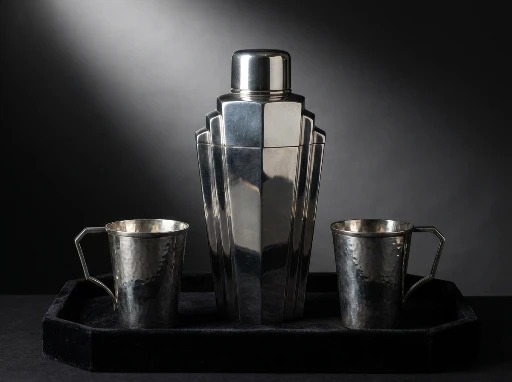
Cocktail silver is a small but lively part of the market. The 1920s and 1930s were the great age of the cocktail, and a good sterling shaker, ice bucket or set of beakers carries the period instantly. Quality and weight matter most here, as does an honest, undamaged finish.
Cigarette Cases and Personal Accessories
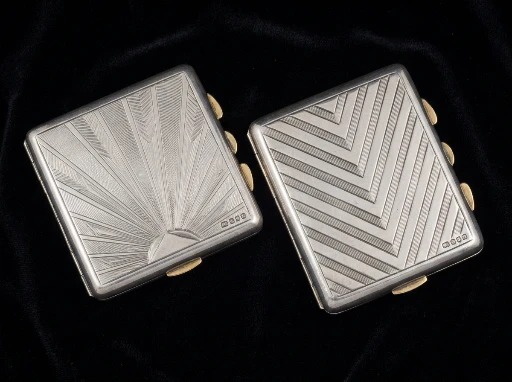
Cigarette cases are among the most widely collected Art Deco silver objects. The 1920s and 1930s were the high point of cigarette culture, and a well-made silver case was a standard accessory for anyone of means. They were produced in huge quantities and survive in large numbers.
The most common examples are engine-turned sterling cases with a simple push-button or thumb-piece opening. They are attractive and well made, but their abundance keeps values modest: a plain engine-turned sterling case in good condition typically fetches £60 to £150 at auction. Do not expect much more without extra features.
Enamel-decorated cases, especially those with pictorial scenes, geometric colour work or niello inlay, are more sought after and can achieve higher prices in excellent original condition. Enamel condition is everything, though: chips, cracks or fading cut the value sharply, and professional restoration is costly.
One important caution. A great many cases from this period are not sterling at all. Gold-filled, rolled gold and gold-plated cases were produced alongside silver and look superficially similar. Always check for clear British hallmarks before assuming a piece is solid, and read our guide on how to read silver hallmarks if the marks are unfamiliar.
Other popular Deco accessories include powder compacts, card cases and the smaller smoking pieces. Collectors of antique silver vesta cases, the matchbox holders that often accompanied a cigarette case, will recognise the same geometric engine-turning here. Complete dressing-table sets in original condition, the matching brushes, mirrors, combs and bottles, are genuinely collectable; incomplete sets much less so.
Art Deco Tea Services
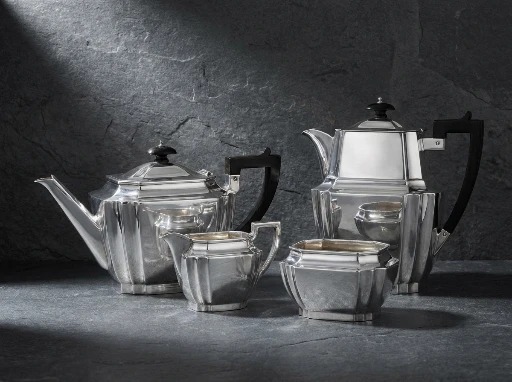
Art Deco sterling tea services are some of the most commercially significant pieces of the period. A well-designed matched set, usually a teapot, hot water jug, sugar basin and cream jug, in good original condition by a known maker is a desirable purchase for collectors and decorators alike.
Values vary with silver weight, quality of design, maker and condition. A matched four-piece Art Deco sterling tea service in good condition by a reputable maker might reasonably reach £400 to £1,200 at a specialist auction, with heavier, better-made examples at the top of that range. Exceptional pieces by prestigious makers can go higher, but those are the exception, not the rule.
British makers whose Deco tea services attract interest include Mappin & Webb, the Goldsmiths & Silversmiths Company, Adie Brothers of Birmingham and Walker & Hall of Sheffield. A mark from one of these firms, with good design and condition behind it, supports a stronger price.
Be aware that many sets described loosely as "silver" are in fact electroplated nickel silver (EPNS). EPNS Deco tea sets are decorative objects, but they sit in a different value bracket from sterling. For the full distinction, see our EPNS versus sterling silver guide.
What to look for in an Art Deco tea service
- Full British hallmarks on every piece, including the teapot lid.
- Matching date letters across the set; mismatched dates suggest assembled pieces.
- Original ebonised or Bakelite handles in sound condition; replaced handles reduce value.
- No splits, dents or repairs to the bodies.
- A maker's mark from a known Birmingham, Sheffield or London silversmith.
- Clean, unpolished surfaces, since over-enthusiastic cleaning removes fine detail and marks.
Not sure if it is sterling or plate?
Send us a clear photo of the marks. We read British hallmarks every day and will identify your Art Deco silver at no charge.
What Affects Value in Art Deco Silver
A handful of factors consistently shape what Deco silver achieves, for better or worse.
| Supports value | Reduces value |
|---|---|
| Sterling with clear, legible hallmarks throughout | Silver plate (EPNS), worth a fraction of sterling |
| Known makers: Mappin & Webb, Adie Brothers, Walker & Hall | Dents, splits or amateur repair |
| Original, undamaged finish: never re-plated or over-polished | Replaced or broken handles, especially non-period ones |
| Complete matched sets with consistent hallmark dates | Incomplete sets: a lone teapot is worth far less than the full service |
| Fine enamel decoration in genuine original condition | Worn or chipped enamel |
| Bold, distinctive Deco design rather than a token nod to the style | Illegible or part-removed marks from over-polishing |
Weight and purity set the floor, but maker, period, condition and rarity decide everything above it. A live metal figure is only a starting point; our silver price valuation guide explains how the two relate.
Art Deco Silver and Inheritance
Many of the Deco pieces that reach the market arrive through estates and inheritances: objects that have sat in a sideboard or cabinet for decades without anyone quite knowing what they are or what they are worth. If you have inherited silver from this period, the first step is always to establish whether it is sterling or plated, and to read the hallmarks carefully.
The honest truth is that the market for antique silver, Art Deco included, is patchy. Some pieces are genuinely valuable; many others are decorative but modest in money terms. An accurate assessment from a specialist beats an optimistic online estimate every time. If your inheritance also includes rings, brooches or other personal items, our team handles silver jewellery alongside the larger pieces.
Selling Your Art Deco Silver
If you are thinking of selling Art Deco silver, whether a single cigarette case or a complete tea service, we would welcome the chance to assess it. At Mozeris Fine Antiques we buy quality Deco silver directly, so you avoid auction-house premiums and delays. You get a straightforward valuation based on current market conditions, not an inflated figure designed to impress.
We are particularly interested in:
- Complete Art Deco sterling tea and coffee services by known makers.
- Enamel-decorated cigarette cases and boxes in good original condition.
- Dressing-table sets in sterling silver with original fittings intact.
- Cocktail shakers, beakers and barware of good quality.
- Larger statement pieces of the period, including angular silver claret jugs.
Our specialists offer free, no-obligation valuations with same-day payment at the Mayfair and Braintree showrooms, or by post. To begin, visit our sell your silver page, call 01376 334 482, or email info@mozerisfineantiques.com.
Frequently Asked Questions

Faustas has over ten years' experience in antique silver and jewellery, specialising in Georgian, Victorian and Regency pieces. He works with private clients and estates from the Mozeris showrooms in Mayfair and Braintree, Essex.
Have Art Deco Silver You'd Like Valued?
Send us a few photographs, including the hallmarks, and our specialists will give you an honest, no-obligation assessment. Free valuation, same-day payment, showrooms in Mayfair and Braintree.