Georgian Silver Tea Caddies: A Collector's Guide
Lockable, beautifully made and once guarding a commodity worth more than its weight in silver, the Georgian tea caddy is among the most charming pieces a collector can own. Here is how to read its shape, its engraving and its marks.
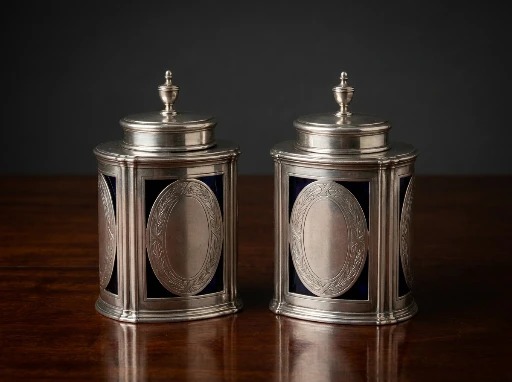
A Georgian silver tea caddy is a small, often lockable box made to store costly tea leaves. The form ran from plain rectangular boxes around 1700 to the slender, bright-cut oval caddies of the neoclassical period. Look for a full hallmark on base and lid, crisp bright-cut engraving, and an intact glass liner. A good single caddy sits around £300 to £700, while a matched pair in its original case can reach £2,500 or more.
Of all the objects a Georgian silversmith produced, the tea caddy is one of the most purposeful and the most quietly elegant. Tea was among the most expensive things a household could buy, so the box that held it was made with real care and almost always given a lock. The housekeeper kept the key, not the servants.
At Mozeris Fine Antiques we buy and sell Georgian caddies regularly, and the same questions come up again and again: what period is it, who made it, and what is it worth? This guide walks through the main shapes, the engraving and liners that mark out the best examples, the hallmarks that confirm them, and the values you can realistically expect today.
Key takeaways
- Caddies evolved from plain early-Georgian boxes to bombé rococo forms and finally the slender neoclassical oval, which is the shape most prized today.
- Bright-cut engraving is the signature decoration of late Georgian caddies. Over-polishing wears it flat, so check our notes on caring for antique silver before you reach for the cloth.
- Many were made in pairs, one for black tea and one for green. A matched pair in its original case is worth far more than two single caddies.
- A full hallmark confirms maker, date and sterling standard. Learn to read it with our guide to silver hallmarks, and check that lid and body marks match.
- Condition drives value: dents, replaced finials, erased armorials and cracked glass liners all reduce a caddy's worth. A specialist valuation tells you where you stand.
What a Silver Tea Caddy Is
A tea caddy is a small, lidded container made specifically for storing tea leaves. The name comes from the Malay word kati, a unit of weight of roughly one and a third pounds, which was the standard quantity in which tea was sold in the eighteenth century.
In Georgian Britain tea was eye-wateringly expensive. It came from China by way of the East India Company and was taxed heavily on arrival. A pound of fine Bohea or Hyson green tea could cost a labouring man a week's wages, which is exactly why caddies were fitted with locks. The housekeeper held the key; the servants did not.
Silver was the natural material for a wealthy household. A silver caddy showed not only that you could afford tea but that you could afford to store it properly. The best examples came from the leading London silversmiths of the day, and the quality of workmanship in surviving pieces is frequently exceptional.
The Main Periods and Shapes
Georgian caddies changed a great deal over the roughly 120 years in which they were made at their finest. Knowing the main stylistic periods makes identifying and dating a piece far easier.
Queen Anne and early Georgian (around 1700 to 1750)
The earliest silver caddies are oblong rectangular boxes, usually with cut corners, a pull-off or sliding lid, and restrained decoration. Engraving, where present, tends to be sparse: an armorial in a cartouche, perhaps, or a simple foliate border. These early pieces have a quiet dignity and are now genuinely scarce. The form was practical and solid, suited to the relative austerity of early Georgian taste.
Mid-Georgian (around 1750 to 1780)
By the middle of the century the rococo had transformed the caddy into something far more elaborate. Vase shapes came into fashion, along with bombé forms whose swollen, curving bodies let the silversmith show off. Straight-sided examples with domed pull-off lids and cast finials were popular too. Chased and embossed decoration of shells, scrolls, flowers and foliage was common on quality work. These mid-Georgian caddies have real visual presence and are much sought after.
Late Georgian and neoclassical (around 1780 to 1820)
The neoclassical movement, driven in Britain by the influence of Robert Adam and by makers such as Hester Bateman and Peter and Ann Bateman, produced what many collectors regard as the finest caddies ever made. The defining form is the oval navette caddy: a slender, boat-shaped box on a pedestal foot, with a pull-off lid topped by an urn finial. Decoration moves from chased rococo ornament to the crisp, linear language of neoclassicism, with swags, husks, fan corners and, above all, bright-cut engraving. This is the period that produced the most recognisable Georgian caddies and the one best represented in today's market.
Pairs, Sets and Fitted Cases
It pays to understand that Georgian caddies were very often made in pairs rather than singly. The reason is practical. Wealthy households kept both black tea (usually Bohea or Congou) and green tea (Hyson or Gunpowder) and stored them apart, so a pair of caddies, one for each, was the standard arrangement. More elaborate sets added a matching glass or silver sugar box, the whole lot fitted into a purpose-made wooden case with a lock.
The difference in value between a single caddy and a complete cased set is significant. A matched pair in its original fitted case is worth considerably more than two individual caddies of similar quality. Complete sets with all three pieces, two caddies and a sugar box, in the original case are rarer still and carry a meaningful premium. If you have inherited what looks like a complete set, do not break it up before getting an opinion on the value of the set as a whole. Our notes on inherited silver are a useful starting point.
Bright-Cut Engraving
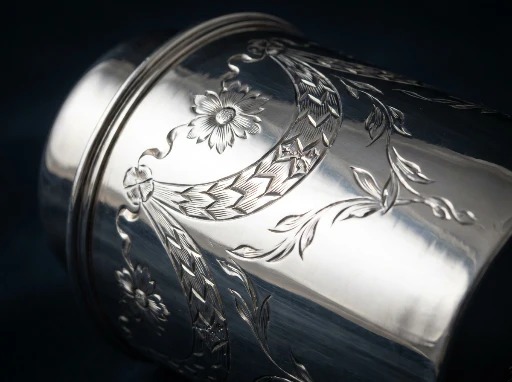
Bright-cut engraving is the most distinctive decorative feature of late Georgian silver, and caddies are among its finest showcases. Unlike ordinary flat engraving, bright-cutting uses a specially shaped tool to lift slivers of metal at an angle, creating faceted cuts that catch and reflect light. The effect is a glittering, almost three-dimensional surface that remains one of the most beautiful techniques in the history of English silversmithing.
On late Georgian caddies you will typically see it used for swags of husks or flowers looped between paterae, bands of running foliage, fan-shaped corner motifs, and an oval cartouche at the centre of each face, often holding an owner's initials or a coat of arms. Quality varies. The finest work, by makers such as the Batemans or Thomas Daniell, has extraordinary precision and depth. Lesser work can be competent but lacks that brilliance.
For a collector, the condition of the engraving matters enormously. Polishing slowly wears away the crisp edges of the cuts, dulling the sparkle and definition. A caddy with fresh, well-preserved bright-cut work in good depth is far more desirable than one polished flat. That is one reason we always advise against over-cleaning Georgian silver. Our guide on how to care for antique silver goes into the detail.
Not sure what your caddy is worth?
Send us clear photos of the piece and its hallmarks. We value Georgian silver every week and will give you an honest figure at no charge.
Glass Liners and Interior Fittings
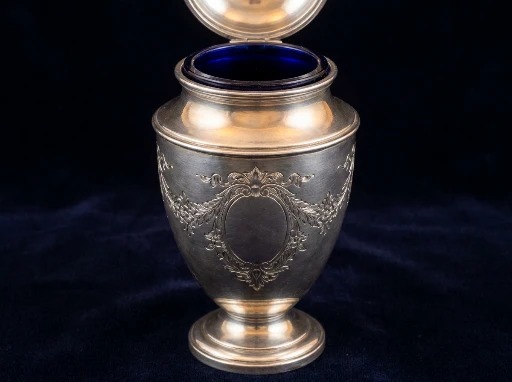
Many late Georgian oval caddies, especially those of the neoclassical period, were fitted with glass liners, most often in cobalt blue, though green glass is also found. The liners had a practical job, protecting the interior and keeping it easy to clean. They also add real visual appeal once the lid is lifted, the rich blue of the glass set against the silver surround.
Missing or damaged liners are one of the most common condition issues on late Georgian caddies, and they do affect value. Replacements can sometimes be sourced, but an original, intact liner in good condition is always preferable. When examining a caddy, lift the lid and inspect the interior carefully. A crack in a blue glass liner that is not obvious from the outside can quietly reduce desirability.
Hallmarks: What to Look For
Every genuine Georgian caddy should be fully hallmarked, and the marks are essential both for authentication and for dating. Our detailed guide on how to read silver hallmarks covers the subject in full, but the key points for caddies are these.
- Assay office: London (a leopard's head) is the most prestigious and most common for fine caddies. Birmingham and Sheffield (the anchor and the crown) also produced large quantities, particularly from the 1770s onward.
- Date letter: allows precise dating to within a year, which helps attribute a caddy to a stylistic period and, in some cases, to a specific maker.
- Maker's mark: the silversmith's initials in a cartouche. Pieces by names such as the Batemans, Paul Storr or Thomas Heming command a premium over unmarked or lesser work.
- Lion passant: the walking lion that confirms sterling silver, 92.5% pure. It is always present on a genuine British-made caddy.
Marks are typically found on the base of the body and, separately, on the lid. If the lid and body do not match in date letter and maker, that is a strong sign the lid is a later replacement, a common fault that reduces value.
Condition and Its Effect on Value
Caddies are small objects that have usually passed through many hands over two centuries, so condition issues are common. The ones to watch for are:
- Dents: particularly to the lid, the most vulnerable part. Minor dents can be eased out by a skilled silversmith, but heavy denting or poor past repairs is a real detractor.
- Replaced finials: the urn or other finial is easily knocked and was often replaced. A later or non-matching finial is obvious to an experienced eye and lowers both authenticity and value.
- Erased armorials or monograms: removing an engraved crest or monogram leaves a thin, slightly concave patch. It looks wrong and, more practically, weakens the silver there. Erasure is common, as later owners wanted rid of the original family initials.
- Worn bright-cut engraving: over-polishing destroys the depth and sparkle. Examine the cuts carefully under a good light.
- Missing or cracked glass liners: a frequent issue on oval neoclassical caddies.
Realistic Values Today
We are always cautious about valuing a piece without seeing it, and you should be equally cautious about figures you read online or hear at a car boot sale. The range of quality and condition in Georgian caddies is enormous, and values reflect that. The table below gives broad guidance for the current market.
| Type and condition | Typical guide price |
|---|---|
| Single oval caddy, well-preserved bright-cut, no real faults | £300 to £700 |
| Plain or lightly decorated single caddy, average condition | £150 to £350 |
| Matched pair in original fitted case, good condition | £1,200 to £2,500+ |
| Named maker (Hester Bateman, Peter & Ann Bateman, Paul Storr) | Premium over comparable unsigned work |
| Significant faults (heavy dents, replaced lid, erased arms) | Well below the figures above |
These are starting points, not promises. Value rests on the combination of maker, period, condition and rarity rather than weight alone. For more on how metal value is calculated, see our silver price valuation guide, and for broader context on Georgian tea wares our guide to antique silver tea services is worth a read.
Selling or Buying a Caddy
Mozeris Fine Antiques are keen, active buyers of Georgian silver tea caddies, whether single pieces, pairs or complete cased sets. We deal in quality Georgian silver from our London showroom at 47 Maddox Street, Mayfair W1S 2PG and our Essex base in Braintree, and we offer free, honest, no-obligation valuations.
We will not quote you an inflated figure to win the business. Our valuations are realistic and based on genuine current market knowledge, which means if your caddy has condition issues, we will tell you plainly what effect they have. Straightforward dealing is better for everyone, and we are happy to advise by email from photographs before any visit is arranged. You can start with a free silver valuation whenever you are ready.
Frequently Asked Questions

Faustas has over ten years' experience in antique silver and jewellery, specialising in Georgian, Victorian and Regency pieces. He works with private clients and estates from the Mozeris showrooms in Mayfair and Braintree, Essex.
Have a Tea Caddy You'd Like Valued?
Send us a few photographs, including the hallmarks on the base and lid, and our specialists will give you an honest, no-obligation assessment. Free valuation, same-day payment, showrooms in Mayfair and Braintree.
Thinking of Selling Antique Silver?
Mozeris Fine Antiques are specialist buyers of antique and sterling silver. Send us photographs — including the hallmarks — for a free, no-obligation valuation. Payment on agreement.
📍 47 Maddox Street, Mayfair · Braintree, Essex · 📞 01376 334 482 · Strictly by appointment