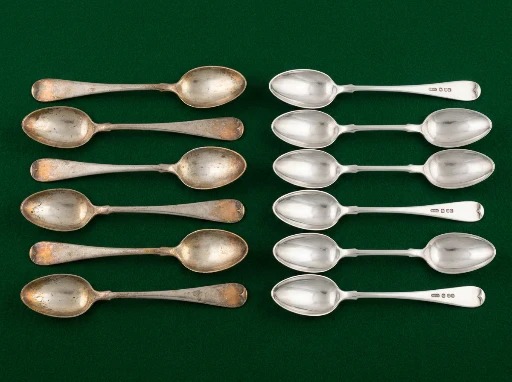
EPNS vs Sterling Silver: How to Tell the Difference
Electroplate and solid silver can look identical across a room, yet one can be worth twenty times the other. Here is how to read the marks, run the right checks, and know which one you are holding.
Solid sterling silver carries a full British hallmark, most importantly the lion passant, and is 92.5% pure throughout. EPNS is electroplated nickel silver: a thin coat of silver over a base-metal core, marked with letters such as EPNS, EP or A1 but never a lion passant. No lion means no sterling, and the value gap between the two is large.
One of the most common questions we hear at Mozeris Fine Antiques sounds simple: "Is this real silver?" The honest answer is that the gap between genuine sterling and electroplate, usually stamped EPNS, is huge in money terms while the two can look nearly identical to an untrained eye. A canteen of cutlery that reads as a handsome Victorian service might be worth £2,000 as sterling, or £80 as EPNS plate.
Getting this wrong is an expensive mistake, so it pays to know exactly what you are looking at. This guide explains what the marks mean, how to separate plate from solid silver, and what each is realistically worth. If you are still unsure after reading, the safest course is a specialist examination, which is precisely what we are here for.
Key takeaways
- The lion passant is the deciding mark. A full British hallmark confirms sterling silver, 92.5% pure. Our guide to how to read silver hallmarks walks through every symbol.
- EPNS, EP, EPBM and A1 are plating marks, not silver standards. None of them means solid silver. See silver plated vs real silver for the full list.
- Worn patches showing a yellow or coppery colour beneath the surface are a reliable giveaway of plate.
- A complete sterling canteen can sell for £1,500 to £4,000; the same pattern in EPNS rarely passes £200. Quick checks live in how to tell if silver is real.
- When marks are worn or absent, treat a piece as plate until proven otherwise, and get it examined before you sell your silver.
What EPNS Actually Means
EPNS stands for Electroplated Nickel Silver. It describes a process developed in the 1840s, shortly after the invention of electroplating, in which a base-metal object is coated with a thin layer of genuine silver using an electrical current. The base is typically an alloy of copper, nickel and zinc, sometimes called German silver or nickel silver despite containing no actual silver.
The method was perfected and popularised by firms such as Elkington & Co. of Birmingham, who held the key early patents. It let manufacturers produce items with the look of solid silver at a fraction of the cost, and it transformed the Victorian table. Middle-class households could suddenly afford settings that looked the part beside aristocratic plate.
EPNS is not the only form of plate you will meet. Other common designations include:
- EP: simply Electroplated, with no base metal specified.
- EPBM: Electroplated Britannia Metal, a pewter-like tin alloy.
- EPWM: Electroplated White Metal.
- A1 or AA: a quality grade used by platers to flag a heavier silver deposit, not a measure of silver content.
- Sheffield Plate: an older process (roughly 1740 to 1840) in which sheet silver was fused to copper by heat and rolling. It is a distinct collecting category and should not be confused with EPNS.
None of these mean solid silver. Every one is a layer of plating over a base-metal core.
How to Tell EPNS from Sterling
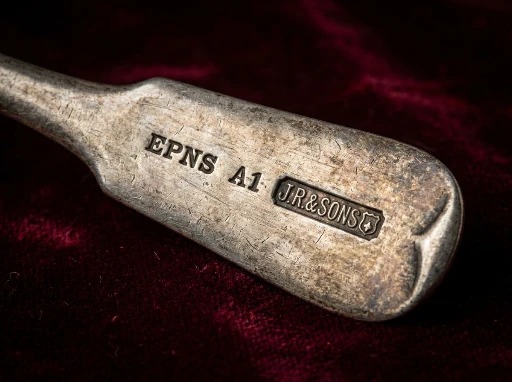
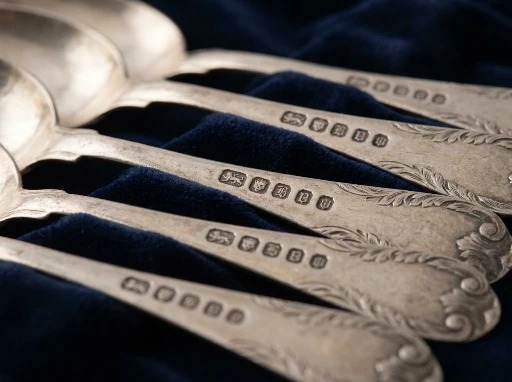
The single most reliable method is to look for a British hallmark. Every piece of solid sterling silver made and sold in the UK has, by law, been assayed and stamped by an official assay office. A full set of marks usually carries four elements:
- The lion passant: a walking lion, the sterling standard mark for 92.5% silver, used since 1544.
- The assay office mark: a leopard's head for London, an anchor for Birmingham, a rose for Sheffield, a castle for Edinburgh.
- The date letter: a single letter giving the year of assay, cycling through the alphabet in changing typefaces and shields.
- The maker's mark: the registered initials or symbol of the silversmith or firm.
EPNS pieces carry none of these. Instead you find the plating designation (EPNS, EPBM, A1 and so on), often beside a maker's cartouche or trade name. To an inexperienced eye these look like hallmarks, since they are small stamps in a row, but they contain no lion passant and no assay office symbol. If you cannot find a lion passant, the piece is almost certainly not sterling. Our guide to silver purity marks sets out every standard mark you might meet.
Physical Tests and Visual Clues
Beyond the marks, a few physical checks help confirm your reading. None is conclusive on its own, but together they build a clear picture.
- Worn patches: plating wears through with use, especially on fork tines, the backs of spoon bowls and high points of relief. A yellow or coppery colour showing beneath the silver is a dependable sign of plate.
- Weight: sterling is noticeably heavier than plated base metal of the same size. Useful, though some base metals are heavy too.
- The magnet test: sterling is not magnetic. If a magnet clings, the base metal contains iron or steel and the piece is certainly not sterling. Many plating metals are non-magnetic, so a clean result does not prove sterling.
- Seams and construction: some early Sheffield plate shows a tell-tale copper edge or seam where the silver has worn back at a join.
A jeweller's loupe is invaluable for reading small marks clearly. Many people misread plating marks as hallmarks simply because they examine them without magnification.
Not sure if it is plate or solid?
Send us a clear photo of the marks. We read British silver every day and will tell you honestly what you have, at no charge.
EPNS vs Sterling at a Glance
Set the two side by side and the differences are easy to keep straight.
| Feature | EPNS electroplate | Solid sterling silver |
|---|---|---|
| Silver content | A thin surface layer, measured in microns | 92.5% pure throughout the piece |
| Marks | EPNS, EP, EPBM, A1; no lion, no assay office | Full hallmark: lion passant, office mark, date letter, maker |
| Core | Base metal (copper, nickel, zinc) | Sterling silver alloy |
| Wear | Plating rubs through to yellow or copper | Wears evenly, same metal all the way down |
| Melt value | Negligible | Real intrinsic value by weight |
| Typical canteen | £80 to £200 | £1,500 to £4,000 |
Why Sterling Is Worth More
The value difference is not snobbery. Sterling silver is 92.5% pure by weight, which carries an intrinsic melt value independent of age or condition. A complete Victorian sterling canteen for twelve, by a known maker such as George Adams or Chawner & Co., might sell at auction for £1,500 to £4,000 depending on pattern, weight and condition. The silver content alone, often several hundred grams, has real worth.
An equivalent EPNS canteen of the same pattern and apparent condition might fetch £80 to £200 at most, frequently less. The silver layer is measured in microns, so there is no meaningful metal value. Its worth is purely as a useful or decorative object.
For single pieces the gap is just as stark. A sterling sauce boat might be worth £200 to £600; an EPNS sauce boat of identical appearance, £15 to £40. These are not exaggerations. They reflect the market as we see it week to week. Our silver flatware value guide goes deeper into what drives cutlery prices.
Is EPNS Worth Anything?
Not nothing. High-quality Victorian EPNS by respected makers such as Elkington & Co., Walker & Hall, Mappin & Webb or James Dixon & Sons holds modest collector interest, especially in elaborate forms like epergnes, biscuit boxes and centrepieces. Early Sheffield plate, predating electroplating, occupies a genuine niche and can achieve respectable prices for good examples.
That said, do not overestimate the demand. The market for decorative silverplate is limited, price-sensitive and slow. It is not a liquid asset in the way sterling is. A handsome Elkington canteen from 1880 is a pleasant thing to own and use; it is not an investment.
If you have inherited a substantial collection of EPNS and wonder whether to sell, the honest answer is that it depends entirely on the specific pieces, their condition and their maker. Approach it with modest expectations. We are happy to give a straightforward opinion without wasting your time.
When You Cannot Tell
Some situations make identification genuinely hard, even for specialists:
- Heavily worn or polished marks: generations of overzealous cleaning can erase marks completely. If marks are unreadable, do not assume the piece is sterling.
- No marks at all: foreign silver, very early pieces and some provincial work may lack a full British hallmark. The safe default for an unmarked piece is plate until proven otherwise.
- Partial marks: a single stamp that might be a lion passant or might be a trade symbol needs magnification and experience to read correctly.
- Mixed pieces: a sterling tray with a plated handle, or a silver body with later electroplated repairs, blurs the overall designation.
In every one of these cases, a physical examination by someone who handles antique silver daily is the only reliable route to an answer. Photographs help, but marks in particular reward a trained eye under magnification.
For more detail on what British hallmarks look like and how to read date letters and assay symbols, see our full guide to how to read silver hallmarks. If you have silver and silverplate mixed together and want to work through it systematically, our guide to inherited silver covers the process.
Frequently Asked Questions

Faustas has over ten years' experience in antique silver and jewellery, specialising in Georgian, Victorian and Regency pieces. He works with private clients and estates from the Mozeris showrooms in Mayfair and Braintree, Essex.
Sterling or EPNS? We'll Tell You Straight.
Send a few photographs, including the marks, and our specialists will tell you honestly what you have and what it is worth. Free valuation, same-day payment, showrooms in Mayfair and Braintree.
Thinking of Selling Antique Silver?
Mozeris Fine Antiques are specialist buyers of antique and sterling silver. Send us photographs — including the hallmarks — for a free, no-obligation valuation. Payment on agreement.
📍 47 Maddox Street, Mayfair · Braintree, Essex · 📞 01376 334 482 · Strictly by appointment