
In this guide (8)
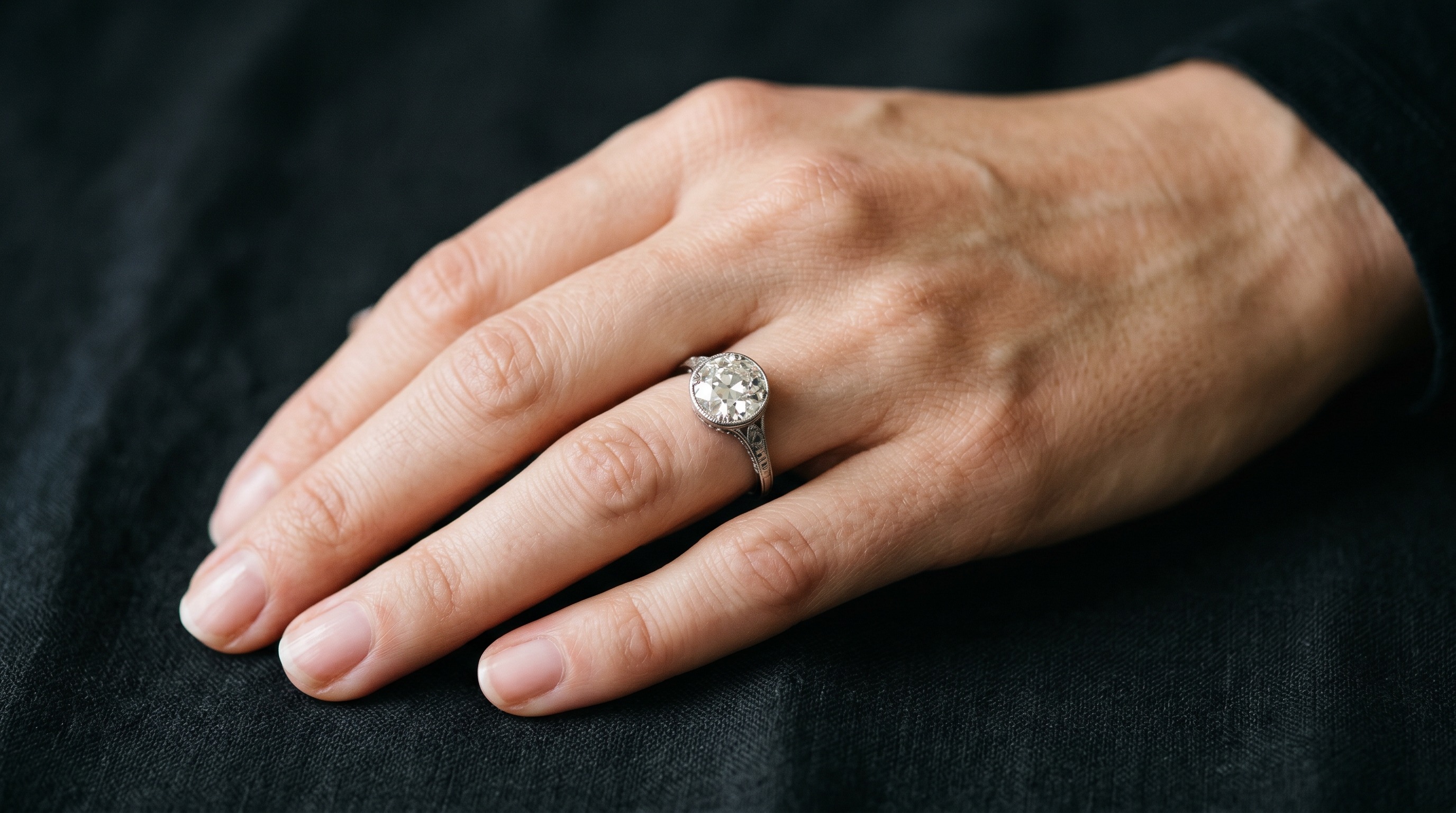
Here is why, and how it sits alongside the wedding ring.
Which finger does a signet ring go on?
In Britain a signet ring is traditionally worn on the little finger of the left hand, the non-dominant hand for most people, so it was out of the way when sealing letters with the other hand. Today men and women wear signet rings on either little finger, and some on the ring finger.
Which finger?
Traditionally the engagement ring is worn on the fourth finger (next to the little finger) of the left hand in the UK, Ireland, the US and much of Europe.
Sell to a specialist
Free valuation from your photographs. Paid the same day after inspection.
- Free insured FedEx collection
- Insured to £10,000
- No obligation
Why that finger?
The custom comes from the ancient belief in the vena amoris, a 'vein of love' thought to run from that finger straight to the heart. The anatomy is a myth, but the romance stuck. Browse our antique engagement rings.
With the wedding ring
At the wedding, the wedding band is placed on first (closest to the heart), with the engagement ring worn above it. Many move the engagement ring to the right hand during the ceremony, then back afterwards.
Customs abroad
In Germany, Russia and some other countries, the engagement or wedding ring is worn on the right hand. There is no single global rule, wear it however feels right.
Frequently asked questions
The fourth finger of the left hand: the 'ring finger', next to the little finger.
From the old belief in the vena amoris, a 'vein of love' thought to run from that finger to the heart.
The wedding band is worn closest to the heart, with the engagement ring above it.
A pinky ring is any ring worn on the little finger. Signet rings are the classic men's pinky ring, often in gold and engraved with initials or a crest, and the Italian tradition favours bold gold pinky rings. Women wear small gemstone, gold or silver rings on the little finger, often stacked or alone.
Little fingers are usually several sizes smaller than ring fingers. Women's pinky rings are often around UK F to J (US 3 to 4¾), and men's around UK J to N (US 4¾ to 6¾). Measure the little finger at the base, because it is narrower there than at the knuckle.
Yes. Thumb rings are worn by both men and women, usually wide plain or chunky bands in silver or gold, or a single stone such as turquoise. A thumb is wider at the knuckle than the base, so an open or slightly larger band helps. Archers' thumb rings were worn to draw a bowstring for centuries.
A diamond engagement ring goes on the fourth finger of the left hand in the UK and USA. Any other diamond ring can be worn on any finger: the right ring finger, the middle finger and the little finger are all common. Wearing a diamond on the left ring finger is usually read as engaged or married.
In Western jewellery there is no rule: a gemstone ring can go on any finger of either hand. In Vedic astrology tradition, a ruby is worn on the ring finger, an emerald on the little finger and a blue sapphire on the middle finger, usually of the right hand. Tanzanite has no traditional finger.
Yes. Emerald and ruby rings are worn on the left hand as engagement rings and as dress rings, and there is no jewellery rule against it. Some astrological traditions prefer the right hand. On either hand, an emerald needs care, because it is more brittle than ruby.
A right-hand ring is a dress or cocktail ring worn on the right hand, chosen by the wearer rather than given as an engagement ring. Antique and vintage right-hand rings include Victorian gemstone clusters, Art Deco platinum rings and large 1940s and 1950s gold cocktail rings.
Antique and vintage gemstone rings in small sizes make good pinky rings, especially Victorian and Edwardian rings, which were often made small. Choose a low setting that will not catch, and check the size can be adjusted. Mozeris Fine Antiques lists ruby, emerald and other gemstone rings with their sizes.