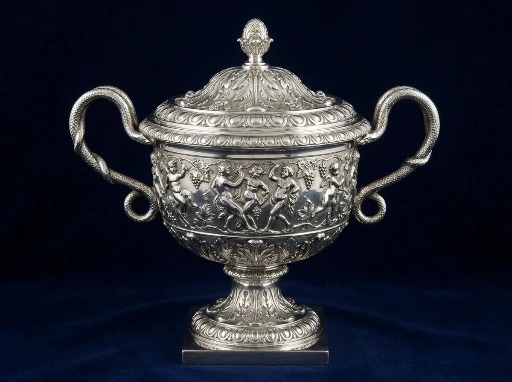
Paul Storr & Regency Silver
More silver crosses our counter as "possible Paul Storr" than any other name. Here is who he really was, how to read the marks, and what Regency silver is honestly worth.
Paul Storr (1771 to 1844) was the most celebrated English silversmith of the Regency period, best known for his work with the royal goldsmiths Rundell, Bridge & Rundell. Genuine Storr pieces are rare and museum-grade, and most silver brought to us as "possible Storr" turns out to be by another maker or a later Victorian copy. A PS mark alone proves nothing: attribution needs the right cartouche, the right date, and a form consistent with his output.
If you have inherited a piece of grand old English silver, the name Paul Storr has very likely come up. "I think it might be Paul Storr" is something we hear most weeks, and the instinct is understandable. Storr is the most famous English silversmith of the Regency era, and his name carries a prestige that has long outlived him.
The trouble is that genuine Storr pieces are extraordinarily rare, command extraordinary prices, and are routinely misidentified. Most silver presented to us as potential Storr proves to be by other makers of the period, later Victorian reproductions in the Regency taste, or unrelated silverware entirely.
This guide gives collectors and sellers an accurate picture: who Storr was, what his work looks like, how to read the relevant hallmarks, and, most importantly, what Regency silver is realistically worth, whether by Storr or by his many accomplished contemporaries.
Key takeaways
- Paul Storr's mark is PS in a rectangular cut-corner cartouche, struck with full London hallmarks of the Regency period.
- The PS initials were not unique to Storr. Worn or misread marks lead to constant misattribution, so the cartouche, date and style all have to agree.
- Regency silver is heavily gauged and neoclassical: gadroon borders, acanthus leaves, figural handles and mythological scenes. Much of it was copied by the Victorians.
- A significant Storr centrepiece can reach tens or hundreds of thousands at auction, but a single PS spoon is worth far less than most owners expect.
- Good Regency silver by other makers is genuinely collectable. See our guides to antique silver tea services and silver salvers and trays.
Who Was Paul Storr?
Paul Storr was born in 1771 and died in 1844. He trained as a silversmith and first registered his maker's mark at Goldsmiths' Hall in London in 1792. His reputation was built above all through a long association with Rundell, Bridge & Rundell, the royal goldsmiths and jewellers on Ludgate Hill, who held the Royal Warrant and supplied the Crown, the aristocracy and the wealthiest patrons of the Regency.
Storr worked for Rundell's in various capacities from around 1807 until 1819. In those years he produced many of the grandest pieces of the period: massive silver-gilt centrepieces, racing trophies, dinner services for royalty, and elaborately cast presentation pieces that now sit in the permanent collections of major museums. He later set up independently with John Mortimer, trading as Storr & Mortimer, before retiring in 1838.
The quality of casting, chasing and finishing from the Rundell's workshop at its height is genuinely exceptional. Storr did not work alone, the workshop employed numerous craftsmen, but the standard of output during his tenure was among the finest ever achieved in English silversmithing. That is why his name still commands such attention.
Identifying Regency Silver Marks
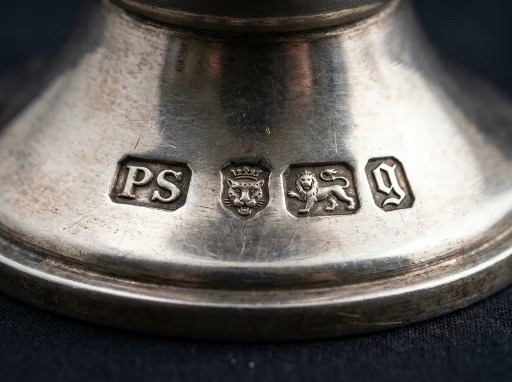
Paul Storr's maker's mark is PS in a rectangular cartouche with cut corners, registered at Goldsmiths' Hall in London. On genuine pieces it appears alongside the full London hallmark sequence. A complete set of London marks from the Regency comprises the following.
- The maker's mark: PS for Storr, but read the caution below before you assume so.
- The lion passant: the standard mark confirming sterling silver, 92.5% pure.
- The leopard's head: the London assay office mark, crowned until 1821 and uncrowned from 1822.
- The date letter: a letter cycling through the alphabet for the year of assay. Regency date letters run from roughly 1811 (letter P in the London sequence) to 1820.
- The sovereign's head: a duty mark used from 1784 to 1890, showing duty had been paid. It is present on most pieces of this period.
Now the critical caution about PS marks. The initials PS were not unique to Paul Storr; other registered silversmiths used the same letters. The mark is also frequently misread, since a worn or poorly struck stamp resembling PS may belong to an entirely different maker. Attribution to Storr needs the correct initials, the correct cartouche shape, the correct date range, and a form and style consistent with his known output. A single table spoon struck with what looks like PS is not Storr work without careful examination by someone who knows the period marks intimately. If you want to work through the marks yourself, our full guide to reading silver hallmarks explains every symbol in turn.
Other Notable Regency Makers
Storr worked within a circle of highly talented contemporaries, several of whom also worked for or near Rundell's.
- Benjamin Smith: one of the most prolific and skilled Regency silversmiths, whose work is of comparable quality to Storr's and similarly sought after.
- Digby Scott: worked in partnership with Benjamin Smith in the early Regency years, producing grand presentation pieces.
- Philip Rundell: registered his own maker's mark and produced pieces under the Rundell's retail umbrella.
- Robert Garrard: took over from Rundell's as royal goldsmith in 1830 and carried the grand Regency tradition into the early Victorian period.
- William Pitts: known for fine embossed and chased work in the neoclassical taste.
Good work by any of these makers is genuinely collectable. The fixation on Storr specifically, while understandable, sometimes leads sellers to overlook the value of other Regency silver they hold. A Benjamin Smith tea service or a Digby Scott wine cooler is a serious piece of English silver history in its own right.
Think you have a Storr piece?
Send us clear photos of the marks and the form. We assess Regency silver every week and will tell you, honestly, what you have.
The Regency Ornamental Style
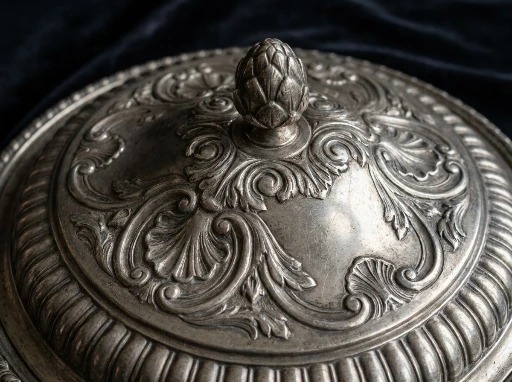
Regency silver is visually distinctive and, once you know it, hard to confuse with other periods. The dominant aesthetic draws on neoclassical sources, ancient Greece and Rome, Etruscan pottery and Egyptian motifs (popular after Napoleon's Egyptian campaigns), combined with a taste for heavy, sculptural ornament that is very much of its own time.
Characteristic features include:
- Gadroon borders: a recurring series of convex lobes around rims and feet, often combined with shells and foliage.
- Acanthus leaf decoration: heavily cast or chased foliage, particularly on handles, feet and body surfaces.
- Figural handles and supports: handles formed as serpents, caryatids, sea creatures or mythological figures; feet cast as lions' paws, hooves or winged monsters.
- Bacchanalian and mythological scenes: vine leaves, grape clusters, putti and classical figures on bodies and lids.
- Shell and anthemion motifs: used as decorative filler and as structural elements at joins.
- Heavy overall weight: Regency silver tends to be generously gauged, with thick, substantial casting compared to much earlier Georgian work.
This style was copied extensively throughout the Victorian period. Many pieces we see that appear Regency in form are in fact mid or late Victorian, made in a retrospective neoclassical taste, with date letters from the 1860s, 1870s or 1880s. These pieces are not without interest or value, but they are not Regency silver and should not be priced or presented as such.
A Realistic Assessment of Value
We will be direct here, because unrealistic expectations about Paul Storr silver cause genuine problems for sellers.
Authentic Storr pieces of any significance, a centrepiece, a wine cooler, a large presentation cup, are museum-grade objects. They appear at major auction houses, they are contested by institutional buyers and serious private collectors, and they realise prices that reflect their extreme rarity. A significant Storr piece can fetch tens or hundreds of thousands of pounds at auction. That is real, but it applies to a vanishingly small number of objects.
A Storr table spoon or teaspoon, common items from the period, is worth considerably less than people expect. The maker's mark adds some premium over anonymous Georgian flatware, but a single spoon or a small set does not become a transformative sum simply by carrying the PS mark. Expect to be pleasantly surprised rather than astonished.
For Regency silver by other London makers, the market is active and prices are real, but they depend enormously on form, size, condition and the presence of undamaged original decoration. The table below shows the kind of ranges we see day to day.
| Type of piece | Realistic guide range |
|---|---|
| Significant authenticated Storr (centrepiece, large cup) | Tens to hundreds of thousands at auction |
| Single Storr table spoon or teaspoon | A modest premium over plain Georgian flatware |
| Attractive Regency silver by other London makers | Often around £300 to £1,500, form and condition dependent |
| Victorian copy in the Regency taste | Valued as good Victorian silver, not Regency |
A pair of sauce tureens with original liners and undisturbed armorials is worth far more than the same pieces with replaced liners and erased crests. What we commonly see are genuinely attractive Regency pieces, real sterling, real age, correct hallmarks, but not by Storr and not in exceptional condition, worth a realistic £300 to £1,500 rather than the £10,000 the owner had hoped for. That is still meaningful money and real antique silver; it simply needs honest expectations. Our silver price valuation guide and our silver versus gold comparison for 2026 put the intrinsic metal value in current context.
Condition Issues That Affect Value
- Erased or re-engraved armorials: armorial engraving is part of the original commission, and removing it leaves a thin, weakened area. Pieces with erased crests are worth meaningfully less.
- Later repairs and replaced parts: solder repairs, or replaced lids, handles or feet that do not match in date or style, harm both authenticity and value.
- Splits and cracks: particularly in thin-walled pieces such as teapots and cream jugs. These are expensive to repair properly and reduce value sharply.
- Over-polishing: repeated mechanical polishing wears away fine detail from chased and engraved decoration, and a heavily polished piece loses the crispness that makes Regency work so admirable.
- Incomplete sets: original sets of any kind are worth substantially more complete than broken up.
Talk to a Specialist First
Mozeris Fine Antiques specialises in English antique silver from the Georgian and Regency periods. We buy regularly and we understand the market for this material in detail. If you have a piece you believe may be by Paul Storr, by another notable Regency maker, or simply by an unknown London silversmith of the period, we can give you an honest, informed assessment.
We would rather tell you straightforwardly what a piece is and what it is worth than give you inflated hopes. We are just as pleased to confirm when something is genuinely significant. It does happen, and when it does we say so clearly and either make a fair offer or advise on the best route to market. You can sell your silver through us, or compare the metal alongside other holdings using our silver versus gold guide.
Bring your piece to 47 Maddox Street, Mayfair, London W1S 2PG, or to our Braintree, Essex CM7 3RU premises. Call us on 01376 334 482, email info@mozerisfineantiques.com, or use our contact form for a quick reply with photographs.
Frequently Asked Questions

Faustas has over ten years' experience in antique silver and jewellery, specialising in Georgian, Victorian and Regency pieces. He works with private clients and estates from the Mozeris showrooms in Mayfair and Braintree, Essex.
Think You Have a Storr Piece?
Send us a few photographs, including the hallmarks, and our specialists will give you an honest, no-obligation assessment. Free valuation, same-day payment, showrooms in Mayfair and Braintree.